
LIFT Economy advocates for ten principles that can help transform our economic systems. Two of those principles, Share Ownership and Democratize Governance, have become even more urgent in the age of artificial intelligence.
AI companies promise that automation will eliminate rote and repetitive tasks, free people’s time, and improve our quality of life. But technology alone will not determine whether those promises are realized.
The more important questions are: Who owns the businesses deploying AI? Who participates in decisions about how it is introduced? And who receives the value it creates?
Unless we change how businesses are owned and governed, the gains from AI are likely to deepen an already extreme concentration of wealth and power.
Why the Wealth Gap Keeps Growing
Our Next Economy MBA participants, clients, and partners frequently express concern about one of the defining economic conditions of our time: a K-shaped economy in which people who already own wealth-generating assets continue to amass more, while many others face greater insecurity.
This widening gap is not accidental. It is shaped by the structures of our economy.
The wealthiest households own a disproportionate share of appreciating assets, including businesses, stocks, land, and real estate. Ownership produces additional income and opens access to more favorable financing, allowing existing wealth to compound.
Meanwhile, people seeking to build worker-owned cooperatives and other shared-ownership enterprises often struggle to access the capital required to launch, acquire, or grow businesses. Conventional education also tends to emphasize individualized and competitive pathways to success, while giving relatively little attention to collective ownership, democratic governance, and community wealth building.
AI is entering this already unequal system.
Unless we deliberately change the structures surrounding AI, it will not automatically produce broadly shared prosperity.
Automation Under Conventional Ownership
Imagine that you work for a conventionally owned company.
You receive notice that AI can now perform half of your regular tasks. Your employer describes this as an exciting productivity breakthrough. From the company’s perspective, it may be. The same work can be completed with fewer paid hours.
For you, however, the outcome may be a reduction in hours, income, or job security. The financial gains primarily flow to executives and shareholders, while workers absorb much of the disruption.
You may have had little influence over which technology was selected, which work was automated, or how the savings would be distributed. The decision may arrive as an announcement after it has already been made.
The technology creates some value, but the ownership structure determines where that value goes, often centralizing wealth into fewer and fewer hands instead of spreading wealth across many for shared benefit.
What Changes When Workers Are Owners?
Now imagine that you work for an enterprise with shared ownership.
You and your colleagues have an economic stake in the business. When AI increases productivity, the benefits do not flow exclusively to distant shareholders or the C-suite.
Worker-owners can collectively decide how to use the gains. Depending on the needs of the business and its workers, that might mean:
Shorter workweeks without a proportional loss of income
Improved wages or benefits
Profit distributions to worker-owners
Additional training and support for people moving into new roles
Reinvestment in the enterprise
Greater contributions to community or ecological priorities
Shared ownership does not guarantee a particular outcome. Worker-owned companies still face difficult financial decisions, competitive pressures, and tradeoffs.
But ownership changes who has a claim on the value created. Workers are no longer treated only as a cost to be reduced. They are among the people who benefit when the enterprise becomes more productive.
Democratic Governance Changes the Process
Ownership is only part of the equation.
Democratic governance gives workers meaningful influence over decisions affecting their livelihoods. Instead of learning about automation through a surprise announcement, workers can participate in conversations about why the technology is being considered, where it could be useful, what risks it introduces, and how its benefits should be distributed.
That does not mean every worker must vote on every operational choice or hold a seat on the board. Democratic organizations take many forms. Some elect worker representatives. Some delegate authority to teams. Others use consent-based decision-making or create specific processes for decisions that materially affect jobs, compensation, and working conditions.
The essential principle is that people affected by a major decision should have meaningful opportunities to shape it.
This can lead to better technology decisions as well as fairer ones. Workers often understand the day-to-day realities of their jobs better than executives, investors, or outside technology vendors. Their knowledge can help identify which tasks are genuinely repetitive, which require human judgment, and where automation might create new risks or reduce the quality of a product or service.
A democratic process can produce stronger implementation, greater trust, and outcomes that better reflect the interests of the whole organization.
What Is Our Time For?
Automation also raises a deeper question: What do we want to do with the time and capacity that technology can free?
Our economy has many jobs devoted to extracting, protecting, and concentrating wealth. At the same time, communities urgently need more people working in care, education, ecological restoration, food systems, affordable housing, public infrastructure, and other forms of work that directly support human and ecological wellbeing.
The goal should not be to preserve every existing job exactly as it is. Nor should it be to automate as much work as possible simply because the technology exists.
We have an opportunity to decide which forms of work we want technology to reduce and which forms of work we want our economy to value, support, and expand.
When productivity gains are broadly shared, people may have greater time and stability to care for family members, participate in civic life, grow food, restore local ecosystems, build community resilience, or pursue creative and educational work.
But this “time affluence” will remain out of reach for most people if automation merely eliminates jobs and concentrates its financial benefits among existing owners.
Building Organizations That Share the Benefits
If we want AI to contribute to greater freedom rather than greater insecurity, we need many more organizations designed to distribute ownership, power, and economic benefits.
That includes worker cooperatives, employee ownership trusts, employee stock ownership plans, steward-owned companies, purpose trusts, democratically governed nonprofits, and other models that separate organizational success from maximizing short-term returns for outside shareholders.
We will also need many more conversions of existing businesses into employee- and community-owned enterprises. As business owners retire over the coming years, the sale of those companies represents an enormous opportunity. They can be acquired by competitors and private equity firms, or they can become locally rooted enterprises owned by the people whose work created their value.
These structures are not peripheral to the conversation about AI. They may determine whether the technology contributes to a more equitable society or accelerates the concentration of wealth and power.
Learning to Design a Different Economy
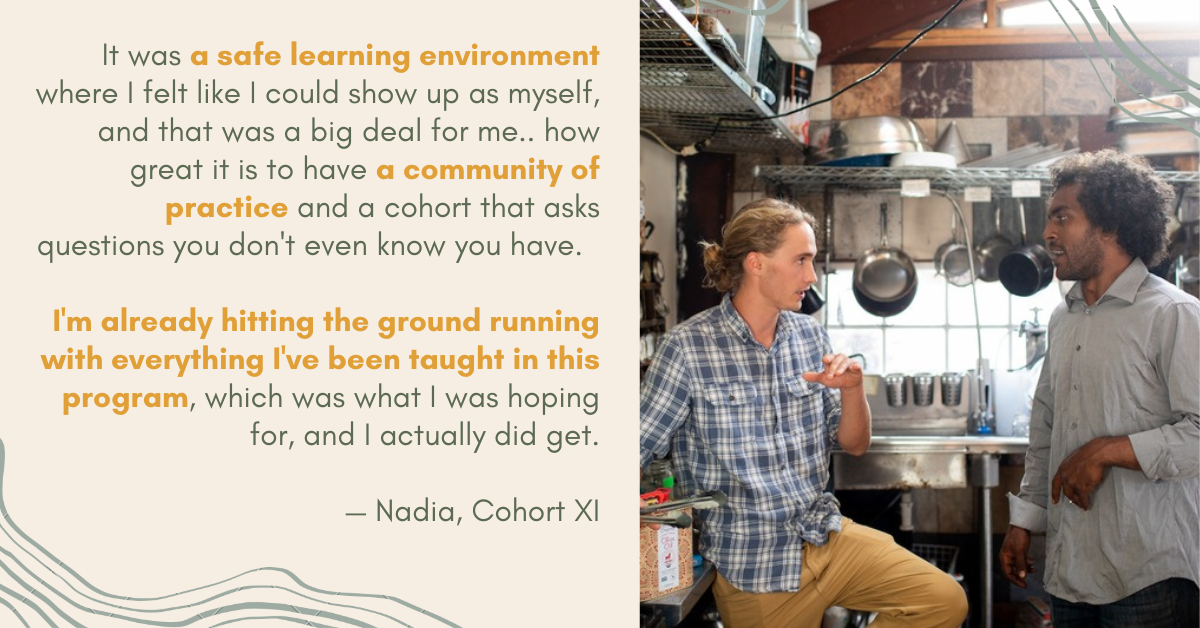
In the Next Economy MBA, we explore the practical skills needed to create and strengthen organizations that serve people, communities, and the more-than-human world.
Participants study shared ownership, democratic governance, steward ownership, alternative financing, organizational culture, strategy, operations, and other tools for designing enterprises that distribute power more equitably.
The upcoming cohort will also include special sessions with leaders including Kat Taylor of Beneficial State Bank, Vincent Stanley of Patagonia, and Eric Ries, author of Incorruptible. These conversations will give participants an opportunity to learn from people who have spent years exploring how finance, ownership, governance, and organizational design can support enduring social and ecological purpose.
Our community of more than 800 alumni is applying these ideas in businesses, cooperatives, nonprofits, farms, investment organizations, community projects, and other efforts to build a racially just, regenerative, and locally self-reliant economy.
AI will not decide whether its benefits are broadly shared. That will be determined by the ownership and governance choices we make.
We can allow the technology to reinforce an economy in which a small number of people own the assets, make the decisions, and receive most of the financial rewards.
Or we can build enterprises in which workers and communities have genuine ownership, meaningful decision-making power, and a fair share of the value they help create.
Curious about what these models could mean for your work or organization? Join our upcoming free Next Economy MBA Q&A to meet the facilitators, learn more about the curriculum and special sessions, and explore whether the program is right for you.