A few weeks ago, I published a LinkedIn post promoting my Beyond the B interview with Douglas Lamont, the CEO, of Tony's Chocolonely.
I opened with a deliberately bold line:
"In my opinion, Tony's Chocolonely belongs in the same credibility conversation as Patagonia."
I really do feel that way. I listed my reasons: Tony's mission-locked legal structure, its Open Chain philosophy, its support for policy change through the Better Business Act in the UK, and other efforts to change the chocolate industry at scale. To me, it did not feel like a particularly controversial take.
Boy, was I naive.
The post generated nearly 104,000 impressions and reached more than 77,000 people, quickly accounting for the vast majority of my LinkedIn impressions during the previous twelve months. Somewhat humorously, there was no comparable spike in podcast activity. The podcast downloads did not rise nearly as much, suggesting that much of the discussion was responding to the comparison itself rather than the full interview behind it.
Supporters of Tony's arrived first. "Love Tony's!" "Aren't they amazing?" Then came the critics with sharper questions: about the company's relationships with conventional cocoa manufacturers, its pricing and traceability claims, how much power farmers actually hold, and whether Tony's visibility crowds out smaller enterprises doing more structurally ambitious work.
I tagged Seth Goldman, one of Tony's three Mission Guardians, and invited him to respond to some of the criticism directly. He did not join the thread, which by that point had become a bit of a sh*tshow. One person said my post read like a paid advertisement.
I replied to nearly every comment, which probably kept the post circulating. The more contentious the exchange became, the further LinkedIn's algorithm seemed to carry it.
The argument underneath the argument
The responses were nominally about cocoa. But underneath, it was the same disagreement I have watched play out dozens of times in the social impact and B Corp space. Do we need larger companies, broader market adoption, and interventions at scale to change the system? Or does real transformation require building smaller, farmer-led, regenerative, and structurally different alternatives outside the dominant system?
The thing many people don't want to accept is that both kinds of work are needed. The most useful framework I have found for holding that tension is one we use at LIFT Economy: the Two Loops model, and the roles of hospice and midwife in the transition to the Next Economy.
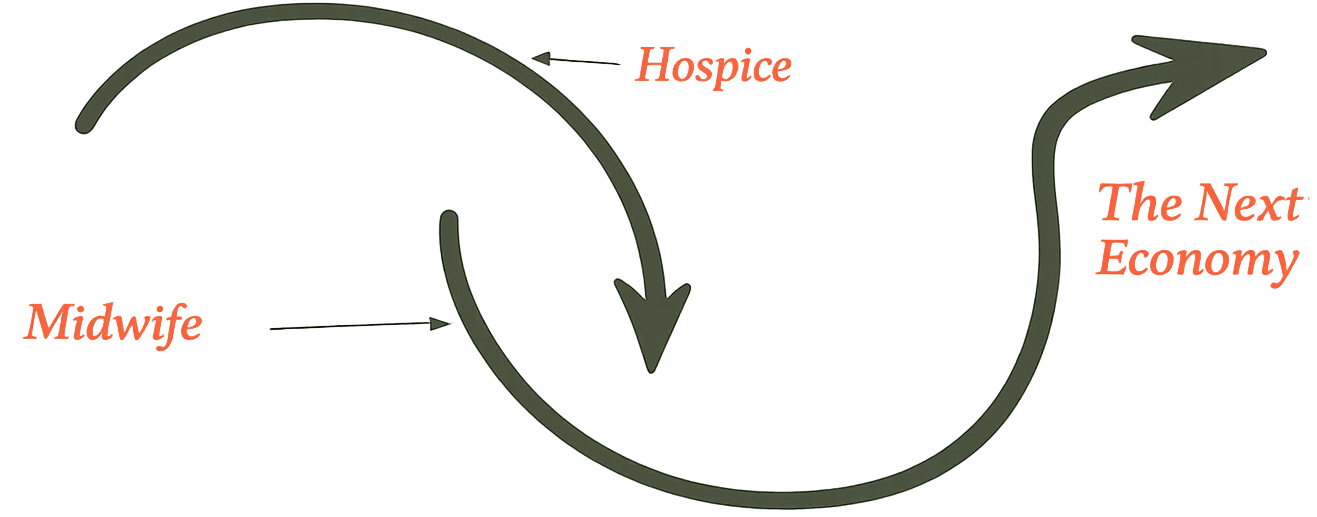
The Two Loops Model (adapted from Deborah Frieze and Margaret Wheatley at the Berkana Institute).
Picture two curves. One traces the dominant economy as it peaks and begins its long decline. The other traces something new emerging underneath it: worker ownership, regenerative agriculture, steward ownership, community-controlled and nonextractive finance, and other models that shift who owns, governs, and benefits from economic activity.
Hospice workers tend the declining curve. They reduce harm within the systems we already have and help extractive institutions change, or die, more responsibly. Think of Walmart pushing renewable energy and emissions reductions through its enormous supply chain. Midwife workers tend the rising curve. They build what could come next, like an Indigenous-owned regenerative enterprise such as Winona's Hemp & Heritage Farm.
Neither can bring about the transition to the Next Economy without the other. Hospice work alone can make an unjust system more tolerable without changing its foundations. Midwife work alone can build beautiful alternatives while millions of people remain exposed to the harms of the economy we actually have.
Once you see the two curves, the cocoa fight, and all the other versions of this same argument among people who ultimately want very similar things, become easier to understand.
Tony's and hospice work
Tony's did not exit the global commodity system to build a small, vertically integrated alternative. It stayed inside the machine. It works with large cooperatives, processors, manufacturers, and retailers, relying on much of the same broad infrastructure used by the rest of the industry. Its five sourcing principles cover traceable cocoa, prices set against a living-income reference, stronger farmer cooperatives, long-term purchasing commitments, and investment in quality and productivity. Through Tony's Open Chain, competing brands can adopt the entire model rather than watching Tony's protect it as a competitive advantage. Douglas described the logic as collaborating in the supply chain and competing on the shelf.
None of this hands ownership of the chocolate industry to farmers, eliminates commodity dependence, or undoes the colonial history of cocoa. What it does is change what happens to a meaningful volume of cocoa right now. When a major retailer signs longer contracts at higher prices, farmers feel the effects. This alone does not transform the cocoa supply chain. It is also not nothing.
The critics were asking midwife questions
Does Tony's give farmers real decision-making power, or better terms within someone else's system? Where does the value actually accumulate? Is the industry moving toward farmer or community ownership, or simply toward a commodity system that is somewhat less exploitative? Does Tony's visibility crowd out attention that could go to smaller, farmer-led enterprises?
One side of the debate was asking how to improve the bulk cocoa market that exists today. The other was asking why we should celebrate an intervention that leaves so much of the underlying structure intact. Both questions are necessary. But the hospice side can write off midwife projects as too small to matter, and the midwife side can write off any compromised intervention as greenwashing. Without a framework like Two Loops, each side can mistake its partial view for the whole. And round and round we go.
“This mission doesn’t get solved in a year or two years. This is 20 years, 30 years of work.”
Tony's does not sit neatly on either curve
Calling Tony's pure hospice work would be too simple. Its Mission Lock places a special share in an independent trust overseen by three Mission Guardians, whose job is to protect the mission through any future change in ownership or leadership. Douglas put the need for that plainly: "This mission doesn't get solved in a year or two years. This is 20 years, 30 years of work." Tony's also supports the Better Business Act and treats its sourcing practices as shared industry infrastructure rather than a competitive advantage.
That puts Tony's between the loops, improving the existing industry while experimenting with structures that could help a different kind of business system emerge. Most purpose-driven companies probably occupy this same complicated middle ground.
What this reveals about B Corp
The same tension runs through the entire B Corp movement. Should certification recognize a relatively small group of structurally transformative companies? Or should it build a demanding pathway that larger and more conventional businesses can realistically travel?
Douglas argued strongly for the big tent. Large companies control supply chains, employment, capital, emissions, and political influence, and a movement that cannot reach them will struggle to change the economy at scale. The midwife warning is equally important. A large, conventionally owned company making credible improvements is not the same thing as a worker cooperative, a steward-owned enterprise, or a regenerative business built around community wealth, even when both carry the same certification.
At its best, B Corp is one of the few places where hospice companies and midwife companies belong to the same community, measure themselves against a shared floor, and sit at the same tables. Certification cannot tell us exactly where each company sits on the curves. Its value may be keeping the two kinds of work in relationship rather than leaving them in separate rooms criticizing one another from a distance.
That only holds if the movement keeps a high bar and a big tent. Drop the bar and B Corp becomes a marketing community. Shrink the tent and it becomes a small identity group with limited influence over the wider economy.
What I learned
My original Patagonia comparison compressed several different questions about scale, governance, evidence, ownership, and transformation into one sweeping verdict. I still believe Tony's belongs in a serious conversation about corporate credibility, mission protection, collective action, and supply chain change. But the more accurate claim is that Tony's is doing serious hospice work at scale while experimenting with midwife-oriented approaches to governance, collaboration, and policy. More farmer-led and structurally transformative enterprises are still needed to show where the cocoa economy ultimately needs to go.
One side of this argument was asking how to improve a massive industry that exists today. The other was asking what a genuinely different cocoa economy could become. The path to the Next Economy runs through both questions.
Curious to learn more?
You can also contact us directly by filling out the form below: