
Where are the Tech B Corps?

Last month I was at the book launch for Incorruptible by Eric Ries (which recently hit the NYT bestseller list). Eric's main argument is that companies that want to be trusted need structural accountability, not just good intentions. He recommends the Public Benefit Corporation as the single most important step any company can take.

B Corps did not come up in any of the discussion. So I asked Eric afterwards how much B Corp certification had come up on his book tour and media appearances. His response was candid: barely at all, which surprised even him.

Why B Corp is Missing

I wasn't surprised. Eric's audience is heavily tech and startup focused. I have done talks in Silicon Valley many times, including events, founder conversations, and lectures at Stanford's business school. The reaction was almost always a blank stare or mild curiosity. At Eric's event, an attendee put it bluntly: "The Venn diagrams of the two worlds do not overlap." I think that's slightly overstated. But it's basically true.

The Venn diagrams of the two worlds do not overlap.
— Audience Member at Eric Ries's book launch

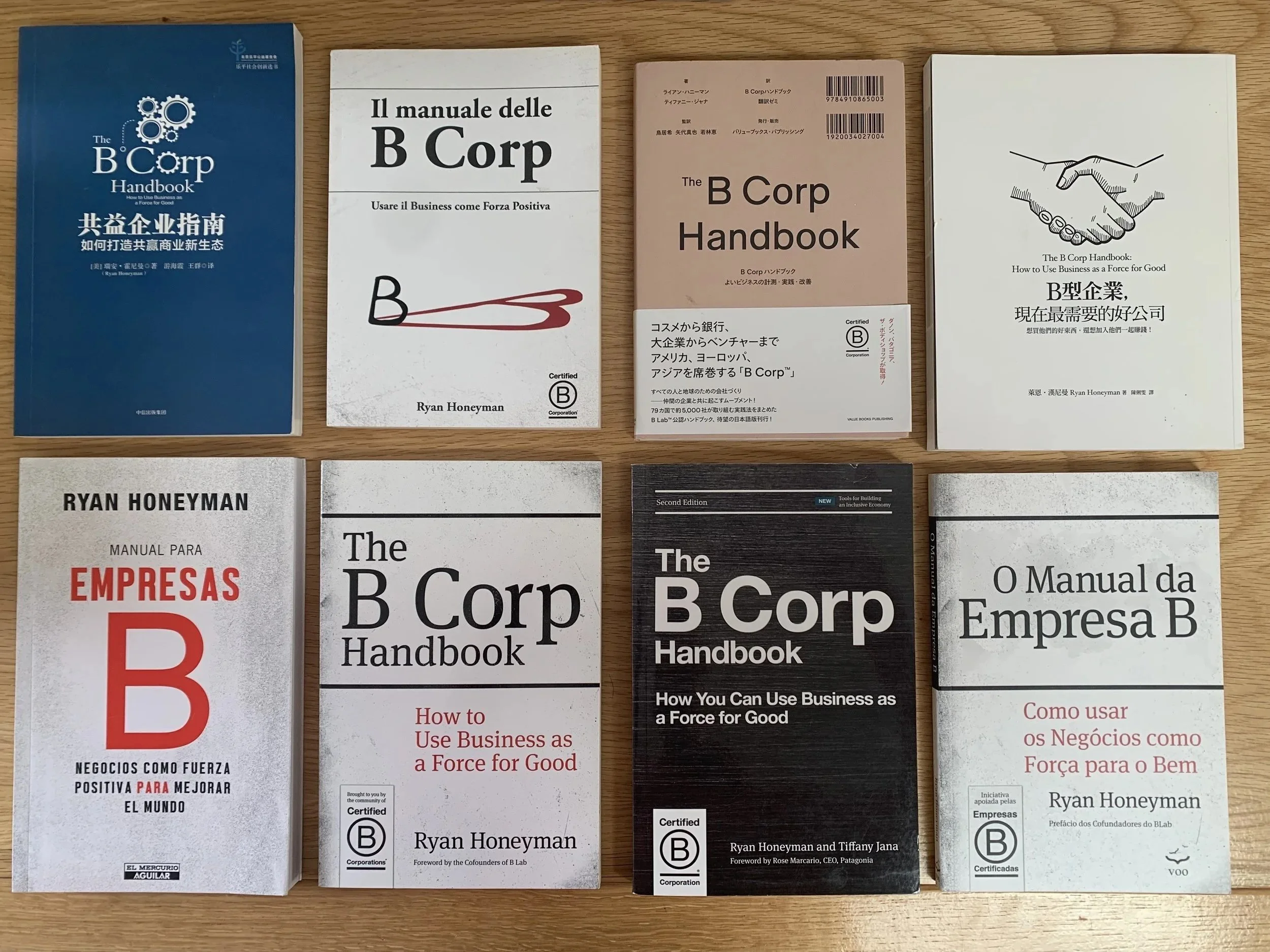
I am now working on the third edition of The B Corp Handbook, so I went looking for big-name tech B Corps. There have been several in the past: Kickstarter, Etsy, Change.org, Hootsuite, WeTransfer, and Rally Software. But none of these are certified anymore. I know there are some--like CultureAmp and Coursera--that are current B Corps. But there are now almost 11,000 B Corps across the world, and it feels like the proportion of big-name tech B Corps has gotten even smaller. What's actually going on?

The High Growth, Silicon Valley Playbook

My take is that the traditional Silicon Valley playbook doesn't leave room for it. The VC playbook demands that companies be "N of 1" innovative disruptors that turn entire industries upside down. But then those same VCs want the most basic, traditional legal and corporate governance possible: the Delaware C Corp. Entrepreneurs are told by their lawyers, investors, and advisors to not mess with how their company is structured or they will struggle to attract top-tier investors. Scale first, figure out everything else later.

For a long time, the legal structure requirement for B Corp certification was a real barrier for companies on an IPO track. Warby Parker and Etsy were both B Corps, but decertified before their respective IPOs because they couldn't (or didn't want to) convert to a PBC (Warby Parker later made the conversion and is currently a B Corp). But the "fear of the PBC" excuse has expired. Anthropic and OpenAI have raised hundreds of billions of dollars in a Public Benefit Corporation structure. More than 60 publicly traded companies around the globe are PBCs. The argument that a PBC makes you uninvestable is not supported by current evidence.

Why Tech Companies Should Reconsider

Here's what I would say to tech companies that are on the fence about certifying: you should definitely do the PBC. But you should also do B Corp certification. The PBC alone is mission lock without accountability. It tells the world you intend to consider stakeholders, but it doesn't verify that you're actually doing it. Doing both the legal mission lock and the independently verified operational standards creates a system of aligned incentives that makes you more resilient. The verification is what makes the mission credible.

Consumer trust in tech companies is arguably at an all-time low. Third-party verified accountability, which is exactly what B Corp provides, is precisely the kind of credible signal that could rebuild it.

Twenty years in, the tech world and the B Corp movement barely overlap. Let's change that.

Questions? Curious to learn more?

You can also contact us directly by filling out the form below:
Walking the Talk, Part 7: Equitable Governance

This is the seventh article in our ten-part "Walking the Talk" series on how companies can move beyond B Corp certification and truly embody their values in daily practice. Parts 1 through 6 covered how leaders model values (Part 1), how values get embedded in strategy and budgets (Part 2), how roles connect to mission (Part 3), how employees learn to apply values on the job (Part 4), how policies and operations are brought into alignment (Part 5), and how stakeholder engagement becomes a genuine feedback system (Part 6).

Part 7 moves deeper into the question of power. Stakeholder Engagement asked organizations to open their decision-making to outside influence. Equitable Governance asks who holds that decision-making authority in the first place—and whether that structure reflects the values the organization claims to hold.

Most organizations that care about equity make it visible in their programs and their public commitments. Fewer make it visible in their governance.

That gap—between how a company talks about equity and how it actually distributes decision-making authority—is one of the most consequential gaps in mission-driven business. It also tends to be the one people are least comfortable naming directly.

What We Mean by Equitable Governance

In the LIFT B Corp Values Assessment, this dimension focuses on four interconnected practices:

  • Decision-making processes intentionally include diverse voices and perspectives—not as an afterthought, but by design.

  • Underrepresented groups have real influence over strategy and direction—not merely a seat at the table, but actual leverage over outcomes.

  • Governance structures are regularly reviewed to ensure they remain fair and inclusive as the organization evolves.

  • Leadership succession and promotion practices reflect a commitment to equity, ensuring that the pipeline itself—not just individual hiring decisions—advances diversity over time.

The common thread running through all four is the word "real." Equitable governance is not the same as diverse governance. An organization can recruit board members or managers from underrepresented groups and still concentrate meaningful authority among a narrow, homogeneous inner circle. What the Values Assessment is probing is whether structural power—over budget, strategy, succession, and direction—is genuinely shared.

Why This Matters

When governance is not equitable, the rest of the framework loses coherence.

Consider the previous six dimensions. Strong leadership commitment, well-aligned strategy, values-driven roles, good employee education, coherent policies, and genuine stakeholder engagement—all of these can exist alongside governance structures that reproduce inequity at the top. When that happens, the organization ends up modeling a subtle but powerful message: equity applies to everyone except the people making the most consequential decisions.

That contradiction does not go unnoticed. Employees, particularly those from historically marginalized groups, read governance structures with precision. When they see who is promoted, who leads high-profile initiatives, who sits in key meetings, and who controls resource allocation, they draw conclusions about what the organization actually values—regardless of what the mission statement says.

And for B Corps specifically: governance structures that concentrate authority among a demographically narrow group sit in direct tension with the stakeholder accountability that B Corp certification requires. Meeting V2.1's Purpose and Stakeholder Governance requirements and genuinely embedding equitable governance are not the same thing. The question this article addresses is the latter.

What Strong Equitable Governance Looks Like in Practice

  • Formally structured decision-making pathways specify who has input, who has voice, and who has authority at each level—reducing the informal power dynamics that tend to favor incumbents.

  • Board and advisory structures reflect the communities the organization serves, with documented processes for identifying and recruiting candidates who expand, rather than replicate, existing representation.

  • Underrepresented groups hold meaningful roles in high-stakes decisions around budget, hiring, compensation, and strategic direction—not just advisory or consultative roles.

  • Regular governance audits assess whether representation at leadership levels is changing over time and whether decision-making processes are functioning as intended.

  • Succession planning begins early, actively identifies candidates from underrepresented backgrounds, and provides sponsorship and development pathways rather than waiting for vacancies to appear.

  • Compensation transparency is tied to governance—because how an organization sets and communicates pay reveals a great deal about whose interests its structures actually protect.

These practices share a common orientation: they treat governance as a designed system, not as the natural result of good intentions. Equitable governance requires architecture, not just aspiration.

Common Challenges and Pitfalls

Confusing diversity with equity. Bringing in diverse voices is necessary but not sufficient. The real test is whether those voices have structural influence. When underrepresented leaders are brought into governance roles but informal power continues to flow through long-standing relationships and processes they were not part of building, diversity becomes a veneer rather than a structural shift.

Relying on informal culture to do the work of formal structure. Many mission-driven organizations believe that because people know each other well and share values, formal governance structures are unnecessary or even counterproductive. In practice, informal cultures without structural accountability tend to reproduce the hierarchies of the broader society. Formalization is not bureaucracy—it is protection for the equity commitments the organization claims to hold.

Episodic rather than systemic review. Governance structures are often reviewed in response to a crisis—a high-profile departure, an equity complaint, a failed hire—rather than on a regular, proactive cycle. By the time a gap becomes visible, significant damage to trust has typically already occurred.

Advancement pipelines that don't match stated values. Organizations can have equitable hiring practices at entry level and deeply inequitable promotion and succession practices at senior levels. If the people making it to leadership are drawn from a narrow demographic regardless of entry-level diversity, the governance structure is working against the equity commitments the organization has made.

Tokenism in high-stakes rooms. Including one or two people from underrepresented groups in a decision-making process—and then proceeding largely as before—is worse than exclusion in a specific way: it provides the organization with a false sense of progress while signaling to those individuals that their perspective is not genuinely valued.

How to Strengthen Equitable Governance

  1. Map where real authority actually lives. Org charts show hierarchy; they rarely show where decisions actually get made. Start by tracing a handful of high-stakes recent decisions—a major hire, a budget reallocation, a strategic pivot—and document who had meaningful input, whose concerns were heard, and whose perspective shaped the outcome. The map this produces is more honest than any formal governance document.

  2. Audit board and leadership composition, then set specific goals. Document current representation across gender, race and ethnicity, socioeconomic background, and lived experience relevant to your mission. Set specific, time-bound goals for change. Vague commitments to "increase diversity" do not create accountability; specific targets do.

  3. Review succession and promotion processes for structural bias. Examine who is being sponsored, who is receiving high-profile assignments, and who is being formally prepared for senior roles. If the answers consistently skew toward a narrow demographic, the process itself needs to change—not just the intentions behind it.

  4. Formalize feedback loops between governance and underrepresented stakeholders. This builds on the stakeholder engagement work from Part 6 but applies it specifically to governance decisions. Create mechanisms by which the communities most affected by the organization's work can provide input on the decisions that affect them most.

  5. Build regular governance reviews into the annual calendar. Once a year, the board or leadership team should formally assess whether governance structures are functioning equitably. This review should include data on representation, promotion rates, compensation equity, and decision-making patterns. The results should be shared with employees.

  6. Name who is accountable. Governance commitments without ownership tend to fade. Identify who is responsible for tracking progress against equity goals, reporting results, and proposing adjustments when the data suggests the current approach is not working.

Examples in Practice

Equal Exchange, the noteworthy worker-owned cooperative, has built equitable governance into its legal structure. Worker-owners elect the board, vote on major strategic decisions, and share in financial returns. The governance structure is not an aspiration—it is the ownership architecture. When governance equity is structural rather than aspirational, it does not depend on individual leaders to maintain it. Any given leader can leave; the structure remains. This is the most durable form of the dimension: not a program the organization runs, but the legal and operational design of the organization itself.

Cabot Creamery, the farmer-owned cooperative and B Corp, offers a parallel example with a different stakeholder configuration. The farmer-members who supply the cooperative hold governing authority—they are not just participants in the business but its owners and directors. When the organization faces decisions about pricing, sustainability investments, or strategic direction, the governance structure ensures that the people most directly affected by those decisions have real influence over them. This is not a function of culture or individual leadership commitment. It is built into the legal ownership design. For organizations that are not cooperatives and are not planning to become one, the principle still applies: who holds formal authority over the decisions that matter most, and does that authority reflect the equity commitments the organization has made?

Reflection Questions for Leadership Teams

  • If you traced the last five major organizational decisions, who had meaningful input, and whose perspectives were most reflected in the outcomes?

  • Are underrepresented groups in your organization in governance roles with actual authority, or primarily in advisory or consultative positions?

  • What does your leadership succession pipeline look like, and who is being actively sponsored and prepared for senior roles?

  • When did your organization last formally review whether its governance structures are functioning equitably, and what changed as a result?

  • What would a person from a historically marginalized background experience as the real power dynamics of your organization—and how does that compare to your formal governance structure?

The Road Ahead

Equitable governance sits at the intersection of structure and culture. Early-stage organizations may begin by auditing current decision-making patterns and setting their first formal representation goals. More mature organizations move toward integrating equity into governance design itself—in ownership structures, board composition processes, succession planning, and the formal pathways by which authority is distributed over time.

The progression from aspiration to architecture is rarely linear. Most organizations will find that naming the gap between their governance practices and their stated values is uncomfortable. That discomfort is productive. It is the entry point for the kind of structural change that actually reshapes culture—rather than the reverse.

The test is the same as in stakeholder engagement: if the people most affected by the organization's decisions cannot point to real influence over those decisions, equitable governance is not yet working as a system.

In Part 8, we'll turn to Impact Measurement and Transparency—how organizations track, report, and act on social and environmental performance data in ways that build genuine accountability rather than just documentation.

Questions? Curious to learn more?

You can also contact us directly by filling out the form below:
Walking the Talk, Part 6: Stakeholder Engagement

This is the sixth article in our ten-part "Walking the Talk" series on how companies can move beyond B Corp certification and truly embody their values in daily practice. Parts 1 through 5 focused largely on internal dimensions: how leaders model values (Part 1), how values get embedded in strategy and budgets (Part 2), how roles connect to mission (Part 3), how employees learn to apply values on the job (Part 4), and how policies and operations are brought into alignment (Part 5).

Part 6 marks a meaningful shift. Stakeholder Engagement is the first dimension in this series that explicitly asks organizations to open their decision-making to outside influence—not just to refine what happens internally, but to let the people most affected by your work help shape it.

There is a significant difference between talking about stakeholders and building genuine systems for them to influence your organization. Many companies do the former. Far fewer do the latter.

What We Mean by Stakeholder Engagement

In the LIFT B Corp Values Assessment, this dimension focuses on four interconnected practices:

  • Having clear systems to gather feedback from employees, customers, suppliers, and community partners.

  • Intentionally seeking input from the people and groups most impacted by your operations.

  • Analyzing that feedback and using it to inform company decisions.

  • Communicating back to stakeholders about how their input influenced your actions.

Together, these describe a feedback loop, not a feedback box. Gathering input is only the first step. The dimension becomes meaningful when that input is analyzed, acted on, and reported back.

The second practice deserves particular attention: seeking input from those most impacted. Most feedback systems are designed around convenience—reaching the stakeholders who are easiest to access. Genuine engagement requires a more intentional effort to include those who often have the most at stake but the least formal access: frontline workers, small suppliers, community members, and people from historically excluded groups.

Why This Matters

When stakeholder engagement is absent or performative, a few things consistently break down.

Decisions get made with incomplete information. Leaders who rely primarily on internal perspectives miss the blind spots that stakeholders would have surfaced—a supplier facing difficult conditions, a frontline employee who sees problems leadership doesn't, a community partner whose concerns keep getting deprioritized.

Trust erodes when engagement is theater. If stakeholders are repeatedly asked for input and never see evidence it was considered, they stop believing the process is real. Employees stop responding to surveys. Community partners disengage. Once this disillusionment sets in, it is difficult to reverse.

And for B Corps specifically: stakeholder governance without stakeholder engagement is a contradiction in terms. You cannot be genuinely accountable to people you are not genuinely listening to.

What Strong Stakeholder Engagement Looks Like in Practice

  • Formal, recurring feedback mechanisms exist for multiple stakeholder groups—not just one. Employee surveys, customer listening sessions, and supplier check-ins are scheduled into the organization's calendar, not done ad hoc.

  • Feedback is analyzed by group. What employees at different levels experience often differs from what suppliers or community partners report. This disaggregation is where patterns become visible.

  • Someone owns the process. A clear internal owner is responsible for synthesizing input, bringing it to decision-makers, and following up on commitments.

  • Decisions visibly reflect what was heard. When changes are made in response to feedback, this is communicated explicitly: what was heard, what changed, and—when something was not addressed—why.

  • The loop is actually closed. Stakeholders know their input was received, reviewed, and acted on—or they receive a specific explanation of why a concern wasn't addressed.

Common Challenges and Pitfalls

Confusing communication with engagement. Sending newsletters, publishing impact reports, and hosting all-hands meetings are valuable. But they are forms of communication, not engagement. Engagement asks something of stakeholders and then responds to it.

Surveying without closing the loop. Annual employee surveys are common. What happens to the results is often invisible. When stakeholders never see their input reflected in decisions, response rates decline and the practice loses its credibility.

Engaging only the easy-to-reach. The stakeholders most likely to respond are often those who already feel empowered. Genuine engagement requires asking who is missing and building channels that work for them.

Treating engagement as a project rather than a system. Many companies do meaningful engagement work during a strategic planning process or before a recertification, then let it fade. Strong engagement is ongoing, not event-driven.

Hearing without acting. This is the most common failure mode. Organizations gather input, then make decisions based on other factors without explicitly accounting for what they heard. When this happens repeatedly, engagement loses its credibility as a practice.

How to Strengthen Stakeholder Engagement

  1. Map your stakeholder groups and identify gaps. Who is most impacted by your operations? Who is currently providing input? Where is there a gap between who has the most at stake and who has real access to your feedback channels?

  2. Establish formal, recurring feedback mechanisms for at least two or three stakeholder groups. Consistency matters more than the specific format.

  3. Assign clear internal ownership. Designate someone responsible for synthesizing feedback, routing it to decision-makers, and following up. Without ownership, this work disappears into competing priorities.

  4. Build a closing-the-loop practice. After each feedback cycle, communicate back to stakeholders what was heard and what changed as a result—or explain honestly why a particular concern was not addressed. This step is what most companies skip.

  5. Review who is excluded. Ask periodically which stakeholders are not being heard and why. Then adapt your feedback channels to reach them, accounting for language access, power dynamics, and structural barriers.

Examples in Practice

Organic Valley, the farmer-owned cooperative and Certified B Corp, offers a strong structural example. Because farmer-members are formal owners of the cooperative, they have built-in governance rights—not just channels to provide feedback, but legitimate influence over direction and decisions. Organic Valley convenes member councils and regional meetings that give farmers direct access to leadership on issues like pricing, production standards, and cooperative priorities. This is not a program layered on top of existing governance; it is the governance. When members raise concerns, those concerns carry institutional weight. The structural design ensures that a primary stakeholder group—the people whose livelihoods depend most directly on the cooperative's decisions—cannot easily be overlooked.

Beneficial State Bank, a mission-driven B Corp bank based in Oakland, approaches stakeholder engagement from a different angle: defining its primary stakeholders as communities that are typically excluded from financial services. The bank tracks who it is actually lending to, disaggregates its impact data by community demographics, and uses that analysis to ensure its capital is flowing toward the people and places its mission prioritizes—not just toward creditworthy borrowers who happen to apply. This is stakeholder engagement embedded in how the business operates: not only gathering input, but structuring products, reporting, and decision-making around the question of whether historically excluded communities are genuinely being served.

Both examples reflect the same underlying principle: the most durable stakeholder engagement practices are those built into how an organization governs and decides—not added as communication exercises afterward.

Reflection Questions for Leadership Teams

  • Who are the stakeholders most impacted by our operations, and how much of our current feedback system is designed around their needs versus our convenience?

  • When we gather feedback, what actually happens to it? Who is responsible for ensuring it reaches decision-makers?

  • Can our stakeholders point to something specific that changed because of their input?

  • Which voices are we consistently missing, and what structural barriers make them hard to include?

The Road Ahead

Stakeholder engagement is where values-to-systems translation becomes visible beyond the organization. The first five dimensions of this series focus on internal coherence. This one asks: are you genuinely open to being shaped by those you say you serve?

Early-stage engagement often looks like ad hoc surveys and informal conversations that don't lead to visible changes. More mature organizations build recurring systems with clear ownership and disciplined follow-through. Full embodiment looks like stakeholder input that is institutionalized—embedded in how the organization governs and decides, not dependent on any individual's initiative.

The test is simple: if stakeholders cannot point to decisions that changed because of their input, engagement is not yet working as a system.

In Part 7, we'll turn to Equitable Governance—how decision-making structures can be designed to include diverse perspectives and ensure that fairness and inclusion are not just stated commitments but organizational realities.

Questions? Curious to learn more?

You can also contact us directly by filling out the form below:
Walking the Talk, Part 5: Policy and Operations Alignment

This article continues our ten-part “Walking the Talk” series on embodying B Corp values in daily practice. In Part 1, we explored Leadership Commitment. In Part 2, we focused on Strategic Integration. In Part 3, we examined Values-Aligned Roles. In Part 4, we turned to Employee Education—ensuring that training, onboarding, and ongoing support equip employees to act in alignment with the company’s values.

Now we turn to Part 5: Policy and Operations Alignment.

If strategy defines your direction and roles clarify responsibility, policies and operations determine what actually happens every day. This dimension is about whether your written policies, internal systems, procurement practices, and operational routines consistently reflect your stated values.

What We Mean by Policy and Operations Alignment

Policy and operations alignment asks a simple but powerful question: Do our systems reinforce our values, or quietly undermine them?

In the LIFT B Corp Values Assessment, this dimension focuses on whether:

  • Written policies reflect commitments to stakeholders, equity, environmental stewardship, and transparency.

  • Operational systems consistently follow those policies.

  • Procurement and vendor selection align with stated values.

  • Day-to-day practices reinforce, rather than contradict, the company’s mission.

It is one thing to articulate commitments to justice, sustainability, or employee well-being. It is another to ensure that hiring policies, supplier contracts, travel guidelines, benefits packages, purchasing standards, and internal workflows consistently reflect those commitments.

Why Policy and Operations Alignment Matters

When policies are misaligned, employees experience friction. They hear leaders speak about equity but see pay transparency handled inconsistently. They hear commitments to climate action but watch procurement default to the cheapest option without environmental criteria. Over time, these contradictions erode trust.

Conversely, when policies and operations are aligned, values become easier to live. Employees do not have to rely on heroic individual effort to “do the right thing.” The system supports them.

Aligned policies also reduce reputational risk. In a climate where stakeholders increasingly look behind the badge, inconsistencies between public messaging and operational reality can quickly surface. Alignment ensures that what is promised externally is reinforced internally.

What Strong Alignment Looks Like in Practice

Organizations that score highly in this dimension often demonstrate several patterns:

  • Clear, accessible policies on topics such as compensation, equity, environmental practices, supplier standards, and employee well-being.

  • Regular policy reviews to ensure alignment with evolving standards and stakeholder expectations.

  • Procurement criteria that include environmental and social considerations alongside cost and quality.

  • Operational metrics that track adherence to policy, not just output.

  • Cross-functional collaboration to ensure that finance, HR, operations, and sustainability teams are not working at cross purposes.

For example, a company committed to reducing its carbon footprint may formalize travel guidelines, require emissions tracking, and integrate sustainability criteria into vendor contracts. A company committed to justice and equity may codify inclusive hiring practices, transparent salary bands, and fair grievance procedures.

In these organizations, policy is a living document that shapes decisions.

Common Challenges and Pitfalls

Even mission-driven companies struggle here. Common challenges include:

  • Outdated policies that no longer reflect current commitments.

  • Inconsistent enforcement across departments.

  • Policies that sound values-aligned but lack operational clarity.

  • Procurement processes that prioritize speed or cost over stakeholder impact.

  • “Shadow systems” where informal practices override written rules.

Often, misalignment is not intentional. It emerges when companies grow quickly or when new commitments are layered onto older systems without full integration.

Strengthening Policy and Operations Alignment

Improving alignment requires disciplined review and cross-functional collaboration.

  1. Conduct a policy audit. Identify key policies that influence stakeholder impact and assess whether they reflect your stated values.

  2. Map touchpoints. Examine how policies show up in daily workflows, from hiring to purchasing to performance management.

  3. Update procurement criteria. Ensure vendor selection and contract terms include relevant environmental, social, and governance considerations.

  4. Clarify accountability. Assign clear ownership for maintaining and enforcing policies.

  5. Establish review cycles. Revisit policies annually to ensure continued relevance and alignment with evolving standards.

  6. Train managers. Ensure those responsible for implementation understand both the intent and the mechanics of each policy.

This work may feel technical, but it is deeply cultural. Systems shape behavior. When systems align with values, culture becomes more coherent and resilient.

An Example in Practice

Consider a B Corp that commits publicly to living wage standards. Alignment would require more than a statement on a website. It might involve formalizing compensation benchmarking, adjusting supplier requirements to encourage fair labor practices, revising pricing strategies to absorb increased labor costs, and tracking compliance across the supply chain.

Another example is a company committed to environmental stewardship that integrates sustainability into product design, logistics, packaging, and vendor contracts. The value is not confined to marketing language; it is embedded in operational decision-making.

In each case, policies create consistency, and operations bring those policies to life.

Reflection Questions for Leadership Teams

  • Do our written policies clearly reflect our core values?

  • Where do daily operational realities diverge from our stated commitments?

  • How do we ensure consistent enforcement across teams?

  • Are our procurement practices aligned with our environmental and social goals?

  • When we update our strategy, do we also update the policies that support it?

The Road Ahead

Policy and Operations Alignment is where aspiration meets discipline. It translates intention into structure and ensures that values are not dependent on individual goodwill alone.

Early-stage organizations may begin by formalizing a handful of core policies. More mature companies create integrated systems where governance, procurement, HR, finance, and operations consistently reinforce shared commitments.

If leadership sets the tone and strategy sets direction, policy and operations set the rules of the game.

In Part 6, we will turn to Stakeholder Engagement—how to design feedback systems and decision-making processes that ensure diverse voices meaningfully shape your company’s evolution.

Questions? Curious to learn more?

You can also contact us directly by filling out the form below:
Walking the Talk, Part 4: Employee Education

This is the fourth article in our ten-part Walking the Talk series on how companies can move beyond certification and truly embody B Corp values in daily practice. After exploring Leadership Commitment, Strategic Integration, and Values-Aligned Roles, we now turn to a dimension that often determines whether values remain aspirational or become part of how people actually work.

Many companies discover that values do not spread simply because they are written down. Without shared learning, values become unevenly practiced. Some employees internalize them deeply, while others are left guessing how values should guide their decisions.

From our experience at LIFT working with 500+ social enterprises over the last 15 years, we have found that employee education is one way to close that gap.

What We Mean by Employee Education

Employee education refers to how well people across the organization understand the company’s purpose, values, and impact commitments, and how supported they feel in applying those values in their work.

In the LIFT B Corp Values Assessment, this dimension looks at patterns such as whether values are reinforced beyond onboarding, whether managers have the language to coach through a values lens, and whether employees feel equipped to navigate real trade-offs. The assessment is designed to help teams surface dynamics they often already sense but have not fully named.

Strong employee education goes far beyond a single onboarding presentation or annual training. It weaves values into onboarding, ongoing learning, leadership development, and everyday conversations, especially when ambiguity or tension arises.

At its core, this dimension asks “have we given our people what they need to live our values well?”

Why Employee Education Matters

Many companies assume that values will naturally cascade once they are documented and communicated. In practice, the opposite often happens. Without shared language and guidance, employees are left to interpret values on their own.

This uncertainty shows up in everyday B Corp decisions. A customer service representative hesitates on a refund because she is fearful of what her manager will say. A manager avoids a tough feedback conversation because values like equity or dignity feel important but hard to translate into expectations. Over time, these moments add up, leading to inconsistent decisions and disengagement.

When education is done well, employees understand how to navigate real trade-offs between stakeholders. B Corp values stop feeling abstract and become practical tools people use when decisions are hard.

What This Can Look Like in Practice

Some organizations begin by focusing on awareness and shared language.

Vector Global Logistics, a U.S.-based Certified B Corp, recognized that while employees knew the company was a B Corp, many did not understand what that meant in practice. During B Corp Month, the company hosted internal B Corp 101 sessions explaining why it pursued certification and how employees could contribute. Interactive activities, including a B Corp-themed bingo game, helped connect impact concepts to real actions and build shared language across roles.

HigherRing, a fully remote Certified B Corp, took a more distributed approach. Leadership integrated employee education into internal communications throughout B Corp Month, sharing short resources, hosting trivia and scavenger hunts, and creating space for dialogue about what certification means in daily work. Education became participatory rather than a one-time delivery.

Both examples reflect employee education efforts focused on building comfort, shared language, and engagement.

When Employee Education Is Deeply Embedded

Some organizations take employee education even further, using it to shape habits, behaviors, and norms over time.

Animikii, an Indigenous-owned digital agency and Certified B Corp, offers a strong example of what this can look like when education is culturally grounded and ongoing. Animikii’s values are rooted in the Seven Grandfather Teachings from Anishinaabe culture: Humility, Truth, Honesty, Wisdom, Respect, Courage, and Love. Rather than treating these values as abstract ideals, Animikii integrates them into how employees learn, reflect, and set goals.

Each year, team members create an Authentic Accountability Agreement, a structured reflection process that aligns professional goals, development priorities, and contributions to the community with the company’s values. Each goal is explicitly connected to one of the seven teachings. Education happens through repeated practice, not a single training. Employees revisit what the values mean in their work, how they show up in relationships, and where growth is needed. Over time, the teachings function as shared norms that guide decision-making, collaboration, and accountability.

How to Strengthen Employee Education, Practically

One of the most common questions leaders ask is “how do we get better, given where we actually are?”

This section is designed to help you identify which description feels most familiar based on lived experience, and to offer a small number of practical adjustments you could realistically make without launching a major initiative.

1 .Minimal Engagement

If there is minimal engagement around your company’s values, it can cause issues. For example, this might look like your values living in leadership language, onboarding slides, or external communications, with little connection to daily work. Employees may know the company is values-driven, but struggle to explain what that means for their role.

To address this, you could try:

  • A short, plain-spoken explanation of why the company chose B Corp or values-based commitments, grounded in one or two real decisions.

  • Concrete examples tied to actual roles.

  • One visible, repeatable signal that values matter, such as a brief reflection at all-hands or a standing question in team meetings.

At this stage, the goal is orientation. People need shared language before they can apply it.

2. Sporadic Engagement

At this stage of cultural embodiment, sporadic is the key word. Some folks on your team may talk about values regularly, while others rarely do. Education shows up in bursts, often driven by individual managers, then fades.

If this sounds like your company, you could focus on:

  • Giving managers a small set of prompts they can rely on when decisions get murky.

  • Folding values into moments that already matter, especially retrospectives, project debriefs, and performance conversations.

  • Appreciating team members in a public way for actions that embody the company’s values. For example, at LIFT Economy, we have an “appreciation” team chat where we appreciate other folks on the team for actions or behaviors that are indicative of our core values.

The work here is about consistency. Values should not disappear once onboarding ends.

Frequent Engagement

At this level, values are already part of the organization’s vocabulary. Employees can generally name them and see how they apply. The work here is about depth and relevance.

You can try strengthening the practice by:

  • Making space for conversations about real tensions and trade-offs.

  • Letting employees influence what education focuses on next, based on where values feel unclear in practice.

  • As a leader, using vulnerability to model where you could have made a decision that better aligns with the company’s B Corp values, and committing to doing better next time. 

At this stage, employee education shifts from reinforcement to being a living and breathing part of the culture. Unfortunately it does need to be continually reinforced (especially by leaders), or the culture will slowly revert back to “average.”

Reflection Questions for Leaders and Teams

  • How do new hires learn what your values look like in practice?

  • Where do employees hesitate because expectations feel unclear?

  • How often do managers explicitly connect values to decisions and feedback?

  • What habits or norms are being reinforced, intentionally or not?

The Road Ahead

Employee education helps connect intention to action. While early efforts focus on awareness, more mature organizations build shared language, habits, and norms that reinforce values through daily practice. Full embodiment occurs when education is continuous, practical, and embedded in how people learn, lead, and decide together.

For teams looking for a structured way to reflect on this journey, the LIFT B Corp Values Assessment can serve as a helpful companion, not as a checklist, but as a conversation starter.

In the next article, we’ll explore Part 5: Policy and Operations Alignment, and how written policies, systems, and everyday practices reinforce the values your people are being asked to live.

Questions? Curious to learn more?

You can also contact us directly by filling out the form below:


Walking the Talk, Part 3: Values-Aligned Roles

This is the third article in our ten-part “Walking the Talk” series, exploring how companies can move beyond certification and truly embody B Corp values in daily practice. After covering Leadership Commitment and Strategic Integration, we now turn to a dimension that often goes overlooked but has outsized influence on whether values show up in real, everyday work.

Values-aligned roles are about clarity, accountability, and coherence. They ensure that every employee, regardless of title or department, understands how their work connects to the mission. When organizations get this right, values stop being abstract aspirations and become part of how people define success in their roles.

What We Mean by Values-Aligned Roles

In the LIFT B Corp Values Assessment, this dimension focuses on three central practices:

  • Every role has a clear connection to the mission, with responsibilities and expectations that reflect the company’s values.

  • Hiring, promotion, and role design prioritize lived alignment with those values.

  • Performance reviews measure how well employees act in accordance with the mission, not just what they produce.

The core idea is simple. People need to know not only what they do, but why it matters in relation to the company’s broader commitments. When responsibilities, incentives, and accountability systems reflect the organization’s intentions, culture becomes easier to maintain and reinforce.

This connection mirrors what we teach in the Next Economy MBA. Roles are one of the most practical leverage points for shifting power, enabling stewardship, and embedding long-term thinking into daily work.

Why Values-Aligned Roles Matter

Most companies articulate their values at the organizational level. Fewer translate those values into expectations for individual roles. Yet this translation is where culture actually lives.

When roles are aligned with values, people are more empowered to make decisions with a clearer sense of purpose. Teams avoid siloed behavior that contradicts the mission, hiring brings in people who will reinforce the culture, promotions reward not just output but how that output is achieved, and employees understand that values are not optional but part of their core responsibilities.

It also creates a pathway for employees—at any level—to practice leadership rooted in care, equity, and stewardship, which is a central throughline in values-aligned organizational design.

This alignment also helps reduce cynicism. Employees can sense when values are only acknowledged at the leadership level and not integrated into their own day-to-day expectations. Clear, values-aligned roles show that the organization is serious about walking the talk.

What Values-Aligned Roles Look Like in Practice

Several patterns show up consistently in organizations that score well in this dimension:

  • Job descriptions explicitly reference the mission, specific values, or stakeholder responsibilities relevant to the role.

  • Teams use routines that reinforce alignment, such as reviewing values-aligned decisions in staff meetings or using decision-making frameworks tied to the B Corp commitments.

  • Performance reviews include clear questions about values, collaboration, equity, stewardship, or community commitments.

  • Hiring practices include behavioral questions, reference checks, and scenarios that test alignment with values.

  • Promotions consider how individuals advance the mission and support a healthy culture, not only whether they hit numerical targets.

When companies do this well, employees often report feeling greater ownership and clarity about how their work contributes to something meaningful. They also see fewer “shadow expectations,” because expectations are explicit rather than implied—a shift that often improves psychological safety and reduces inequity.

Common Challenges and Pitfalls

Many companies intend to align roles with values but struggle to operationalize it. Job descriptions that mention values only in an introductory paragraph but do not embed them into responsibilities. Hiring practices might rely heavily on technical skills and overlook behavioral indicators of alignment. Performance reviews might focus on quantitative outcomes without assessing how those outcomes were achieved. Promotion criteria could reward individual output more than collaboration or cultural leadership. Ultimately, there is often a lack of shared language around what values look like in real behavior.

These challenges often reflect a deeper reality. Translating values into role expectations requires clarity, definition, and ongoing reinforcement. It is work that cannot be rushed or delegated.

In our coaching and consulting work, we regularly see that companies avoid this step because it forces difficult conversations about power, accountability, and whose definition of “good performance” gets centered.

How to Strengthen Values-Aligned Roles

The following steps help organizations move from intention to practice:

  • Review all job descriptions and identify where the mission and values can be made explicit and practical.

  • Develop behavior-based indicators for what values look like in action and incorporate them into hiring and promotion processes.

  • Integrate values into performance reviews with concrete criteria or questions.

  • Train managers on how to evaluate values-aligned behavior in a consistent, fair way.

  • Include values-aligned responsibilities directly within goals, OKRs, or work plans.

  • Build rituals that reinforce alignment, such as reflection prompts in team meetings or debriefs after difficult decisions.

Small adjustments in these areas often create major shifts in how employees perceive and internalize the mission. Even linking quarterly goals to a specific stakeholder or value helps make alignment feel practical rather than inspirational.

Examples from Real Companies

RSF Social Finance offers a clear illustration of what values-aligned roles can look like in practice. RSF convenes investors, borrowers, and staff in quarterly pricing meetings to help determine RSF Prime, a customized interest rate for their social enterprise loan program. These meetings create direct connection and transparency among stakeholders and give employees a real role in weighing the needs of all parties when making decisions.

This stands in sharp contrast to conventional finance, where investors or lenders typically hold the decision-making power and set interest rates unilaterally. In most traditional lending models, borrowers have little visibility into how rates are determined, and staff are tasked primarily with implementing decisions made elsewhere. RSF’s approach distributes influence, invites dialogue, and makes relationship-centered decision-making part of the day-to-day responsibilities of staff. Instead of values living in a mission statement, they show up in the structure of how financial decisions are made and who gets to shape them.

Free Resources from LIFT

Many teams struggle with how to translate these ideas into their own structures and expectations. Here are two free tools we designed that you can use to support your work.

  • Example Role Descriptions: First, here is a sample set of social and environmental responsibilities for manager roles across departments. It provides concrete language companies can adapt when refreshing job descriptions so expectations about impact and stewardship are built in from the start.

  • Example Performance Review: Second, here is the performance review template we use internally at LIFT that shows how cultural habits, values, and functional responsibilities can be reflected in annual evaluations. Teams often tell us it helps turn abstract values into clear expectations.

Together, these tools offer a simple way to move from intention to practice by making values visible in both role design and ongoing accountability.

Reflection Questions for Your Team

  • Do employees understand how their roles connect to the mission and stakeholders?

  • Are values embedded in hiring, not just described?

  • How consistently are values assessed in performance reviews?

  • What behaviors are rewarded in promotions?

  • Where do responsibilities or incentives unintentionally conflict with the company’s commitments?

These questions can spark important conversations about where alignment already exists and where deeper work is needed.

Where This Fits in the Embodiment Journey

Values-aligned roles build directly on the first two dimensions. Leadership sets the tone, strategic integration embeds values into plans and budgets, and this third dimension translates those commitments into expectations for every person in the organization. Without this step, values remain broad statements. With it, values become part of how people define success.

This translation step also enables the next dimensions, such as employee education and operations, to take root because people understand the why behind the changes being introduced.

In the next article, we’ll explore Part 4: Employee Education, which focuses on how onboarding, training, and ongoing development equip employees to act in alignment with your company’s mission.

If you’d like support refining job descriptions, performance reviews, or hiring practices to reflect B Corp values, our team is always happy to help.

Questions? Curious to learn more?

You can also contact us directly by filling out the form below:
Walking the Talk, Part 2: Strategic Integration

This article continues the “Walking the Talk” series exploring what it means to truly embody B Corp values. Part 1 focused on Leadership Commitment—the foundation for everything that follows. Part 2 turns to Strategic Integration, the process of embedding B Corp principles into strategy, budgets, incentives, and leadership priorities so that values are not a parallel initiative but the framework that guides every decision.

Strategic Integration is the second dimension in the LIFT B Corp Values Embodiment Assessment. In this section, participants reflect on questions such as:

  • Are B Corp principles built into our company’s strategy and performance indicators?

  • Does our budget include clear resources for environmental, social, or equity goals?

  • Are leadership incentives tied to values-aligned outcomes, not just financial ones?

  • Do we regularly assess major decisions through a stakeholder lens?

  • Are long-term strategic goals guided by both mission and profit?

These prompts are not about compliance. They reveal whether purpose is embedded in the organization’s structure or remains something leaders talk about but do not operationalize.

Why Strategic Integration Matters

When B Corp values are missing from strategic and financial planning, good intentions can quietly erode under short-term pressures. Without formal alignment, purpose work risks becoming side projects dependent on individual enthusiasm rather than company design.

Strategic Integration ensures that values inform how success is defined, how money is spent, and how performance is measured. It translates moral commitment into measurable action. A company that integrates its values strategically does not balance purpose against profit—it understands them as interdependent.

What Strategic Integration Looks Like in Practice

Organizations that demonstrate strong integration consistently show the following traits:

  • Impact goals are woven into strategic plans and reviewed alongside revenue and profit targets.

  • Budgets include recurring allocations for sustainability, equity, or community programs.

  • Compensation and bonuses reflect progress on values-driven objectives.

  • Decision-making frameworks explicitly consider stakeholder impacts.

  • Progress toward social and environmental outcomes is reviewed regularly with the same rigor as financial metrics.

These practices make B Corp values a living part of how the organization plans, prioritizes, and measures performance.

Common Challenges and Pitfalls

Many companies with genuine intent struggle to move from rhetoric to integration. Common barriers include things like treating impact goals as separate from business strategy; underfunding purpose initiatives; setting qualitative goals without measurable targets; maintaining incentives focused solely on profit or growth; failing to revisit and refine goals as circumstances change.

These gaps make it difficult to hold the organization accountable and often lead to disconnection between leadership messaging and operational reality.

Strengthening Strategic Integration

Using the B Corp Values Assessment as a guide, companies can strengthen integration by following several practical steps.

  1. Review your baseline results in Section 2 of the Free B Corp Embodiment Assessment to identify where strategy and resource allocation already align with B Corp values and where they do not.

  2. Translate values into specific, measurable objectives with clear owners and timelines.

  3. Integrate impact metrics into your strategic and budgeting cycles so they are reviewed consistently.

  4. Tie compensation and recognition to both performance and purpose.

  5. Fund your commitments. Allocate dedicated resources rather than relying on discretionary spending.

  6. Revisit goals annually to ensure that priorities and incentives continue to support your mission.

Over time, these steps turn purpose alignment into a repeatable management discipline rather than an aspirational statement.

Example in Practice

King Arthur Baking Company, a 100 percent employee-owned B Corp, offers a strong example of integration. Ownership itself is a structural expression of values, giving employees a voice in governance and aligning financial outcomes with community and environmental commitments. Each year, strategic and operational goals are developed through a participatory process that balances profit, mission, and stakeholder well-being.

Reflection Questions for Leadership Teams

  • How well do our strategy and budget reflect our stated values?

  • Are incentives and performance reviews connected to impact outcomes?

  • Do we consider stakeholder impacts before major decisions?

  • How do we handle trade-offs between profit and purpose?

  • What systems ensure that our values remain visible and actionable year to year?

The Road Ahead

Strategic Integration is the point where vision becomes structure. It gives purpose an operating system and ensures that leadership commitment translates into action. Early-stage companies may begin by setting one or two measurable impact goals. More mature organizations establish systems where budgets, incentives, and governance consistently reflect their mission.

Wherever your organization begins, remember that if it is not part of the strategy or the budget, it is not yet a priority.

Part 3 of this series will focus on Values-Aligned Roles—how every position in the company can contribute to mission and impact, making embodiment everyone’s responsibility.

Questions? Curious to learn more? Here are some resources our team has put together for you:

You can also contact us directly by filling out the form below:
B Corp v2.1 Updates: Deadlines, Audits, & What It Means for You

B Lab recently announced a round of updates about the new B Corp Standards—and they’re worth your attention. Some tighten expectations, some buy a little more time, and all of them confirm that this transition is one of the most complex the movement has ever seen.

V1.6 Deadline Extended to February 2026 (For New Certifications Only)

Here’s the headline: companies applying for their first B Corp certification under the current V1.6 standards now have until February 2026 to submit.

That’s a shift from the long-stated December 31, 2025 cutoff. For months, B Lab had framed that date as final. So this two-month extension caught a lot of people by surprise. It’s limited to newly certifying companies—not existing B Corps—but it says a lot about the scale of this rollout. The extra time reflects how complex the shift to the new standards has become.

Third-Party Audits, New Multi-Year Framework, & 5 Year Cert Timelines?

The new certification process officially introduces third-party audits. Independent assurance providers will now review documentation and performance instead of B Lab handling it all internally.

On top of that, the certification itself will unfold over multiple checkpoints—Year 0, Year 3, and Year 5. Year 0 sets the baseline, Year 3 adds new expectations, and Year 5 verifies long-term integration. This approach raises the bar for credibility and continuous improvement, which is good for the movement but means companies will need to stay sharp and organized over time.

The certification period itself is also expanding from two years to five. That means once certified, companies will be evaluated less often but held to higher, ongoing expectations through the Year 3 and Year 5 checkpoints.

v2.1 Certification Overview (source: B Lab)

The New 10-Step Certification Pathway

B Lab has now laid out, for the first time, a clear visual roadmap of the full certification journey—from registration and self-assessment through third-party audit and the five-year recertification cycle. The process confirms what many of us expected: certification will require more documentation, more follow-up, and more rigor. For anyone planning to certify or recertify, it’s worth studying this 10-step overview closely.

Branding and Messaging Updates Coming in 2026

B Lab plans to release a new brand book in January 2026. It’ll spell out how companies can use the B Corp mark, what claims are approved, and which messaging will be reserved for companies meeting the new standards.

If your business uses the B logo on packaging or in marketing, get ready to refresh your materials next year. This shift is all about protecting the credibility of the brand and ensuring impact language matches verified performance.

Alignment with the EU’s ECGT Directive

B Lab continues to align the new certification framework with the EU’s Empowering Consumers for the Green Transition (ECGT) Directive. The goal is to ensure B Corp certification remains a legally compliant, trusted mark for sustainability claims in European markets.

For a deeper dive, I wrote about this intersection here: New Updates: What B Corps Need to Know About ECGT (LinkedIn).

What Does This All Mean?

These updates show a massive amount of behind-the-scenes work from B Lab. They’re trying to build a stronger, fairer, more globally consistent certification process—and to their credit, they’re doing it while the plane is still flying.

It’s a lot to absorb. The timelines are shifting. The verification process is new. The standards are tougher. And yet, I’m confident it’ll all shake out in the right direction. If you want to dig deeper or start preparing your own company for the transition, here’s where to go next:

  • Read B Lab’s latest blog post on the new certification updates (bcorporation.net)

  • Check out my ECGT article on how this connects to the EU’s ECGT Directive (LinkedIn)

  • Reach out to our team at LIFT Economy to talk through how these changes might affect your business (lifteconomy.com):

Important Updates: What B Corps Need to Know About ECGT

By Ryan Honeyman, Partner at LIFT Economy

Disclaimer: I am not a lawyer. This article is not legal advice. It’s a summary of information released on 10/1/2025 by B Lab and other sources I have pulled together. If you think ECGT may apply to your company, please consult your own legal counsel.

What is ECGT? The Empowering Consumers for the Green Transition Directive (ECGT — Directive 825/2024/EU) is new EU legislation designed to prevent greenwashing and help consumers make informed choices about sustainability. It does this by banning vague or misleading environmental claims, tightening rules around sustainability labels, and requiring more credible third-party verification.

Like data privacy laws (think GDPR), ECGT applies based on where consumers are located — not where your company is based. That means any B Corp marketing to EU consumers could be in scope, whether or not you have an EU office.

ECGT will be enforced starting September 27, 2026.

Why B Corps Should Pay Attention: B Lab has been preparing for this moment for a long time. Under the new B Lab Standards (version 2.1) and certification model:

  • B Corp certification will qualify as a valid sustainability label under EU law.

  • Third-party verification will be provided by ISO 17021–1 accredited providers.

  • Companies certified on v2.1 will be able to confidently communicate their B Corp status in the EU without running afoul of ECGT rules.

In short: transitioning to the new standards is the simplest way for B Corps to meet ECGT requirements and reduce risk. More details just released by B Lab here.

Step 1: Self-Identify. B Lab is asking all B Corps to log into the B Impact platform and self-identify whether ECGT impacts your company. This is due by October 31.

To do this:

  1. Log in to B Impact.

  2. Go to Manage Account.

  3. Select Company and look for the “Regulatory Information” section.

  4. Under “EU Empowering Consumers for the Green Transition (ECGT),” click Add and complete the form.

Even if B Lab prompts you, the responsibility lies with your company to determine applicability. If unsure, consult your legal advisors.

A Simple Logic Test for ECGT Applicability. This test is based on the EU’s Unfair Commercial Practices Directive (UCPD), which ECGT amends. Under the UCPD, what matters is whether your commercial practices are directed at EU consumers and whether you make environmental claims.

Step 1: Do you target EU consumers? You’re “targeting” the EU market if you:

  • Ship products to the EU or offer EU shipping options.

  • Price in euros or use EU-specific payment systems.

  • Translate your site into EU languages or use EU-specific domain names (e.g., .fr, .de, .eu).

  • Run online ads targeted at EU geographies.

  • Sell through EU-based distributors, resellers, or online marketplaces (e.g., Amazon EU, Zalando).

  • Have EU retail partners or brick-and-mortar availability.

Step 2: Do you make environmental or sustainability claims? These include:

  • General terms like “green,” “eco-friendly,” “sustainable,” “climate positive,” or “planet safe.”

  • Claims of “carbon neutrality” or “net zero” (especially if based on offsets).

  • Durability or recyclability claims (e.g., “biodegradable,” “100% recyclable packaging,” “lasts twice as long”).

  • Use of sustainability labels or logos (unless they come from a recognized certification scheme).

If you answer yes to both, ECGT likely applies to your company. Even if it seems clear that ECGT applies, it is still critical to consult your own legal counsel before making a final determination.

What to Do if ECGT Applies

  • Recertify on v2.1 standards before September 2026. This ensures your B Corp certification is recognized as valid under EU law.

  • Complete the Self-Assessment in B Impact. This helps you identify and close gaps early.

  • Prepare to adopt the new B Corp logo use and claims guidelines by September 2026.

  • Submit for recertification as soon as possible after January 1, 2026. This sounds bananas but its true. Because ECGT takes effect in September 2026, this means B Corps that need to recertify only have a few months to complete the process. Acting early is essential to avoid bottlenecks and reduce compliance risk.

Why This Matters. ECGT introduces penalties of up to 4% of turnover for non-compliance in the EU. Beyond fines, the bigger risk is reputational damage if your sustainability claims are challenged.

By certifying (or recertifying) on B Lab’s new standards, B Corps can:

  • Avoid the risk of being accused of greenwashing.

  • Use a trusted, third-party-verified sustainability label.

  • Strengthen credibility with consumers and investors.

Final Thought. ECGT is another reminder that sustainability communication needs to be precise, substantiated, and credible. For B Corps, the good news is that the path to compliance is clear: adopt the new B Lab Standards (v2.1), use the updated claims and brand guidelines, and stay ahead of the 2026 deadline.

This isn’t the final word — laws are still being transposed at the member-state level, and details may evolve. But now is the time for B Corps to self-identify, prepare for recertification, and start internal conversations.

If your company needs support navigating ECGT readiness and the new B Lab standards, you can reach out to LIFT Economy. We are actively helping B Corps prepare for these changes and can guide you through the process.

Resources:

Walking the Talk, Part 1: Leadership Commitment

This article kicks off a 10-part series called “Walking the Talk: A 10-Part Journey to Embody B Corp Values.” This series explores the ten dimensions of embodiment—a framework the LIFT team developed to help B Corps and purpose-driven companies move beyond certification and truly live their values.

And yes—we’re bringing back the 200-point scale (with a wink). While B Lab moves away from numeric scoring, we see value in using the number as a symbol of full embodiment: a playful yet powerful way to remind leaders that “walking the talk” can still be measured.

Certification can be an important milestone, but the deeper work is embedding values into the DNA of your organization so that they show up in every decision, relationship, and outcome. Over the coming months, we’ll explore each dimension in detail, starting here with Leadership Commitment—the cornerstone on which all the others depend.

To recap, here are the 10 dimensions we laid out if our initial article How to (Actually) Embody B Corp Values:

  1. Leadership Commitment: Leaders model B Corp values, communicate openly, and personally engage in mission-driven work.

  2. Strategic Integration: B Corp principles are built into strategy, budgets, and ongoing leadership priorities. Compensation, incentives, and rewards are tied directly to values-aligned outcomes.

  3. Values-Aligned Roles: Every role ties to the mission, with performance measured by impact and purpose. Hiring and promotion decisions prioritize alignment with values.

  4. Employee Education: Training, onboarding, and support equip employees to act in alignment with values.

  5. Policy and Operations Alignment: Written policies, systems, procurement, and daily practices consistently reflect and reinforce company values.

  6. Stakeholder Engagement: Feedback systems ensure diverse voices shape decisions and drive improvements.

  7. Equitable Governance: Decision-making includes diverse perspectives and ensures fair, inclusive structures.

  8. Impact Measurement and Transparency: Social and environmental outcomes are tracked, shared, and used in decisions.

  9. Recognition and Celebration: Achievements are recognized and celebrated to reinforce culture and impact.

  10. Systems Change Orientation: The company uses its voice and influence—through advocacy, collaboration, and partnerships—to help transform the underlying systems driving social and environmental challenges.

Leadership Commitment is #1 on this list for a reason. That article, based on the LIFT B Corp Values Assessment, highlights three essential practices: leaders consistently model B Corp-aligned behaviors in their daily actions and decisions; they communicate openly about progress and challenges in meeting social and environmental goals; and they actively participate in initiatives that advance the mission and values, rather than simply delegating them. These practices signal that embodying values isn’t a side project—it’s central to how the organization operates.

Why Leadership Commitment Matters

Leadership sets the tone for the entire organization. When actions align with words, credibility and inspiration follow; when they don’t, cynicism grows. Culture is shaped less by mission statements than by the daily behaviors leaders model. Transparent and vulnerable leaders also help teams sustain momentum when challenges arise, while active engagement anchors accountability so that values don’t slip into neglect.

What Authentic Leadership Commitment Looks Like

Authentic commitment shows up in ways that are easy to see. It looks like leaders making routine decisions through the lens of values, not just special initiatives. It means communicating openly about both wins and setbacks. It shows up when leaders personally participate in mission-driven work rather than outsourcing responsibility. And it requires consistency across strategy, budgeting, and performance reviews, along with public accountability through clear goals, progress updates, and openness to feedback.

Common Challenges and Pitfalls

Even well-intentioned leaders can fall short. The most common pitfalls include:

  • Values as rhetoric, not practice. Pressures like tight deadlines or financial targets can tempt shortcuts.

  • Delegation without ownership. When leaders step back too far, initiatives lose visibility.

  • Selective transparency. Sharing only wins undermines trust; failures need to be surfaced too.

  • Sporadic involvement. When attention to values is inconsistent, employees begin to treat them as optional.

Steps to Strengthen Leadership Commitment

Moving from aspiration to embodiment requires intentional effort. Leaders can start with an honest self-assessment using tools like the LIFT B Corp Values Assessment. From there, they should define specific behaviors and make them measurable. Embedding commitments into regular routines—team meetings, strategic planning, and budgeting—ensures they don’t slip off the agenda. Allocating time and resources allows leaders to participate meaningfully in mission-aligned work, while modeling accountability through public goals and progress reporting makes values visible. Finally, practicing humility—acknowledging mistakes and inviting feedback—turns values from abstract ideals into lived realities.

An Example in Practice

B Corps like Namasté Solar illustrate what this looks like. Their “Big Picture” meetings bring every co-owner, including leadership, into transparent conversations about performance and direction. Leaders don’t just oversee culture from a distance; they participate in community projects and equity efforts, showing that values are shared responsibilities, not slogans.

Reflection Questions for Leaders

  • Where do my actions diverge from our stated values?

  • How do I handle trade-offs between financial outcomes and social or environmental commitments?

  • Do I share both wins and setbacks with transparency?

  • In what ways do I personally engage in mission-aligned initiatives?

  • How do I and my peers hold one another accountable to our values?

The Road Ahead

Leadership commitment exists on a spectrum. At an early stage, formal statements may exist, but actions are inconsistent. With moderate alignment, communication happens regularly but integration remains incomplete. Strong alignment emerges when leaders consistently model values and practice transparency. And full embodiment occurs when values guide strategy, culture, and decisions so deeply they are inseparable from leadership itself.

Wherever your organization is today, the essential point is this: leadership is the foundation. Without leaders modeling values, communicating honestly, and showing up personally, the rest of the work risks becoming hollow. With strong leadership commitment, however, the other dimensions of embodiment have a chance to take root and flourish.

In the next article, we’ll explore Part 2: Strategic Integration—how to embed values into strategy, budgets, compensation, and resource allocation so that leadership commitment moves from aspiration to concrete, organization-wide practice. Together, these two dimensions form the backbone of what it means to walk the talk as a B Corp.

Questions? Curious to learn more? Here are some resources our team has put together for you:

You can also contact us directly by filling out the form below:

How to (Actually) Embody B Corp Values in Your Organization

By Ryan Honeyman, Partner at LIFT Economy 

In my experience helping 100+ companies certify as B Corps, I would estimate that less than 25% of them truly embody B Corp values across their leadership, culture, and operations.

About 50%-60% are making real—yet inconsistent—progress towards authentically living B Corp values. The final 15-20% meet the minimum requirements but do not deeply live the values, and may even be at reputational risk if employees or customers look behind the badge.

That disconnect is risky. In today’s business climate, claiming B Corp status without embodying the values can backfire—damaging trust with employees, customers, and communities.

Certification, I’ve come to realize, is only the beginning. The deeper and more transformative opportunity is helping companies weave B Corp values into the daily fabric of leadership, culture, and operations. [Hint: Our free B Corp Values Assessment tool helps you do that!]

A quick note on language: When I say “embodying B Corp values,” I don’t mean simply promoting the certification or being a visible brand champion. I mean living the underlying principles the B Corp community aspires to—stakeholder governance, equity and justice, environmental stewardship, transparency, and accountability—whether or not a company talks about them publicly. Some companies both embody these values and advocate for the movement. Others may be strong advocates but fall short on embodiment. Either way, advocacy has its place, but embodiment is the foundation.

Why Embodying B Corp Values Matters

Before defining B Corp values, it’s important to be clear: there is no single, formal list published by B Lab that declares “these are the values.” Instead, what we call B Corp values is a synthesis—pulled from sources like the Declaration of Interdependence, the benefit corporation legal framework, various iterations of the first set of B Corp standards (v1.0-v1.6), the second evolution of standards (v2.0-v2.1 and beyond), as well as community gatherings and interactions between the B Corp community.

B Corp values—when you gather them across these sources—include topics like stakeholder governance, environmental stewardship, employee well-being, justice and equity, and community engagement. These are not meant to sit in a binder or be buried on a shared drive. They are meant to guide decisions, shape strategy, and inspire everyday behavior.

10 Dimensions of Embodiment

To “embody” means to give form to something intangible—to make it visible and real through actions, systems, and behaviors. From my experience, the following ten dimensions offer a practical roadmap for how B Corps can actively live their values day-to-day:

  1. Leadership Commitment: Leaders model B Corp values, communicate openly, and personally engage in mission-driven work.

  2. Strategic Integration: B Corp principles are built into strategy, budgets, and ongoing leadership priorities. Compensation, incentives, and rewards are tied directly to values-aligned outcomes.

  3. Values-Aligned Roles: Every role ties to the mission, with performance measured by impact and purpose. Hiring and promotion decisions prioritize alignment with values.

  4. Employee Education: Training, onboarding, and support equip employees to act in alignment with values.

  5. Policy and Operations Alignment: Written policies, systems, procurement, and daily practices consistently reflect and reinforce company values.

  6. Stakeholder Engagement: Feedback systems ensure diverse voices shape decisions and drive improvements.

  7. Equitable Governance: Decision-making includes diverse perspectives and ensures fair, inclusive structures.

  8. Impact Measurement and Transparency: Social and environmental outcomes are tracked, shared, and used in decisions.

  9. Recognition and Celebration: Achievements are recognized and celebrated to reinforce culture and impact.

  10. Systems Change Orientation: The company uses its voice and influence—through advocacy, collaboration, and partnerships—to help transform the underlying systems driving social and environmental challenges.

Together, these dimensions show what it means to walk the talk every day.

The Gap Between Certification and Culture

Unfortunately, here is some of what I have witnessed over the past 15 years working with purpose-driven companies: policies that look good on paper but aren’t consistently followed. Leaders who speak values publicly but fail to model them internally. Employees who start out inspired but disengage when they don’t see follow-through. Without intentional effort, B Corp values risk becoming aspirational statements rather than lived realities.

Examples from Real B Corps

Here are a few B Corps that show what embodiment looks like in practice:

  • King Arthur Baking Company (Strategic Integration): 100% employee-owned since 2004, King Arthur has embedded accountability into its very governance structure. Ownership isn’t a policy on paper—it’s a lived reality that ensures workers have a real voice in the company’s direction, aligning decisions with long-term mission rather than short-term profit.

  • New Belgium Brewing (Operational Alignment): Long before carbon accounting was mainstream, New Belgium implemented an internal “energy tax” to fund renewable projects and ultimately became the first national beer company to release a carbon-neutral beer, Fat Tire. Sustainability is not a side project—it’s hardwired into how the company operates every day.

  • Seventh Generation (Impact Measurement and Transparency): This Vermont-based household products company publishes detailed annual impact reports that openly track progress toward ambitious 2025 climate and equity goals. By sharing both successes and setbacks, they’ve built a culture of transparency and continuous improvement that keeps them accountable to stakeholders.

  • Namasté Solar (Stakeholder Engagement): As an employee-owned cooperative in Colorado, Namasté Solar practices open-book management and hosts regular “Big Picture” meetings where every co-owner can engage in strategy and performance. These recurring rituals ensure that values aren’t abstract—they’re reinforced through everyday habits and shared decision-making.

A Tool to Help You Begin

To help companies bridge the gap between certification and culture, LIFT created the free B Corp Values Embodiment Assessment. It’s a simple, practical tool you can use with your leadership team to:

  • Identify strengths and celebrate what’s working.

  • Pinpoint gaps that need attention.

  • Prioritize where to focus next.

  • Spark a constructive, forward-looking conversation about how values show up in daily practice.

The assessment uses a straightforward frequency scale (“Always” to “Never”) to quickly reveal patterns and trends. It’s designed to be a mirror, not a grade—giving you a baseline and a map for progress.

For fun—and as a subtle nod to the original B Impact Assessment—our assessment brings back the classic 200-point scale. Think of it not as a return to competition, but as a lighthearted reminder that what gets measured (and celebrated) gets lived.

Your Next Step

If you’ve already certified, congratulations—that’s a milestone worth celebrating. But certification alone is not enough. The true power of B Corp is unlocked when your organization fully embodies its values—in governance, in operations, in culture, and in the daily decisions that shape your future.

Start by downloading and completing the B Corp Values Embodiment Assessment with your leadership team. Then revisit it annually—or even quarterly—to track your progress.

And if you want help turning insight into action, that’s the work I’m most passionate about now. At LIFT Economy, we support B Corps and mission-driven companies in going beyond the badge—aligning leadership, systems, and culture so values aren’t just claimed, but lived every day.

Questions? Curious to learn more? Here are some resources our team has put together for you:

You can also contact us directly by filling out the form below:
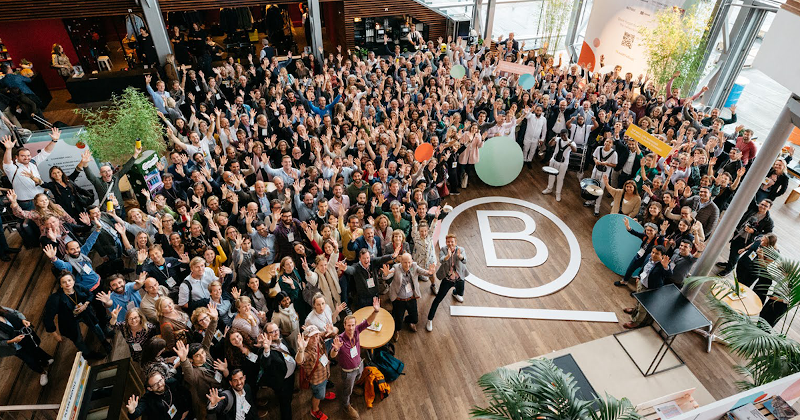
12 Things to Look for When Hiring a B Corp Consultant (2026)

Becoming a B Corp is more than just obtaining a certification—it's about embedding purpose into the fabric of your business. The journey can be complex, requiring strategic changes and a deep commitment to social and environmental responsibility. Hiring the right B Corp consultant can make all the difference.

With many options available, how do you choose the right one for your business? This article will guide you through the essential factors to consider when selecting a B Corp consultant, ensuring you find a partner who can help you achieve certification and drive long-term success.

1. Experience with the B Corp Certification Process

Navigating the B Corp certification process requires a thorough understanding of B Impact and the ability to tackle various challenges along the way. An experienced consultant can guide you through these complexities, helping to ensure a successful certification.

What to Consider:

  • How many companies has the consultant successfully guided to certification?

  • Can they provide examples of businesses similar to yours that they’ve worked with?

  • Do they have a proven track record of navigating the complexities of the B Impact platform?

A consultant with significant experience will help make the process smoother and more effective, ensuring that your company meets the rigorous standards required.

2. Is the Consultant’s Firm a Certified B Corporation?

When a consulting firm is B Corp certified themselves, it adds a layer of credibility and shows that they truly understand the certification process from the inside out. This also demonstrates that they practice the principles they advocate for their clients.

What to Consider:

  • Is the consulting firm B Corp certified?

  • How long have they maintained their certification?

  • How do they score in key areas like governance, workers, community, and environment?

A B Corp-certified consultant brings firsthand experience and a genuine commitment to the same principles your company is striving to uphold.

3. Have They Completed the B Consultant Training from B Lab?

When considering a B Corp consultant, it can be helpful to check whether they are certified as a B Consultant by B Lab. This certification (while not a requirement for a consultant to help companies with the B Corp certification process) can help indicate that the consultant has undergone specialized training and is recognized by B Lab for their expertise in guiding companies through the B Corp certification process.

What to Consider:

  • Is the consultant certified as a B Consultant by B Lab?

  • What specific training have they completed through B Lab’s certification programs?

  • How does their B Consultant certification enhance their ability to assist with your B Corp journey?

A consultant who is certified by B Lab brings a level of credibility and specialized knowledge that can be invaluable in navigating the certification process and achieving the desired outcomes for your business.

4. Beyond B Corp: Addressing the Deep Design of Your Business

Achieving B Corp certification is an important milestone, but the journey doesn’t end there. The best consultants can help you go beyond certification, embedding social and environmental impact into the deep design of your business. This could involve rethinking your business model, governance structure, and stakeholder engagement.

What to Consider:

  • Does the consultant offer services that extend beyond certification?

  • Can they help you reimagine the foundational design of your business to maximize impact?

  • How do they approach long-term sustainability and systemic change?

A consultant who can help you address the deep design of your business ensures that your company not only achieves certification but is also fundamentally aligned with regenerative practices and systemic impact.

5. Comprehensive Service Offerings

The B Corp certification process can involve a variety of tasks, from legal restructuring to governance changes and ongoing impact assessments. It’s beneficial to work with a consultant who offers a comprehensive suite of services to support your business through every stage.

What to Consider:

  • What services do they provide beyond certification?

  • Do they assist with legal requirements, governance, and impact reporting?

  • How do they support ongoing improvement post-certification?

A consultant with a broad range of services can guide your business from certification through sustained impact, helping you maintain and enhance your B Corp status over time.

6. Connections within the B Corp Community and B Lab

Being part of the B Corp community offers access to a powerful network of like-minded businesses. A consultant who is well-connected within this community and with B Lab can provide valuable introductions, insights, and support.

What to Consider:

  • How active is the consultant in the B Corp community?

  • Do they have strong relationships with B Lab and other B Corps?

  • Can they connect you with other businesses or resources that might be beneficial?

A consultant with deep connections in the B Corp community can open doors to additional resources and networking opportunities, adding significant value to your certification journey.

7. Experience with Justice, Equity, Diversity, and Inclusion (JEDI)

Incorporating Justice, Equity, Diversity, and Inclusion (JEDI) is vital to achieving B Corp certification and making a meaningful impact. A consultant with experience in JEDI can help your company meet these important standards.

What to Consider:

  • What experience does the consultant have with JEDI initiatives?

  • How do they incorporate JEDI into their consulting practice?

  • Can they provide examples of how they’ve helped businesses enhance diversity and inclusion?

A consultant with strong JEDI expertise can guide your company in creating a more inclusive and equitable workplace, which is crucial to achieving and maintaining B Corp certification.

8. Proven Results and Client Testimonials

The impact of a consultant’s work is best measured by their results. Look for testimonials, case studies, or references from previous clients to evaluate their effectiveness.

What to Consider:

  • Can the consultant share testimonials or case studies from previous clients?

  • What measurable results have their clients achieved after certification?

  • How do they measure success in their engagements?

Positive feedback from past clients can provide confidence that the consultant will help your business achieve its goals.

9. Additional Resources and Expertise

A good consultant will bring a wealth of additional resources and expertise to the table, beyond just certification. This might include access to specialized tools, frameworks, or knowledge that can help your business thrive.

What to Consider:

  • What additional resources does the consultant offer?

  • Do they provide access to tools or frameworks that can aid your certification and beyond?

  • How do they stay updated on the latest trends and best practices in the B Corp movement?

A consultant who offers additional resources and expertise can significantly enhance the value of your engagement, helping you leverage every opportunity for growth and impact.

10. Thought Leadership and Industry Influence

Thought leadership in the B Corp space signals that a consultant is not only keeping up with industry trends but also shaping them. A consultant who is recognized as a leader in the field can bring valuable insights and innovative approaches to your business.

What to Consider:

  • Does the consultant contribute to thought leadership in the B Corp community?

  • Are they recognized as an authority in the field, speaking at conferences, or publishing relevant content?

  • How do they use their influence to drive positive change within the B Corp movement?

Working with a consultant who is a thought leader can provide your business with cutting-edge strategies and a deeper understanding of the evolving landscape of social and environmental impact.

11. Staying Ahead of New B Corp Standards

The B Corp movement is continuously evolving, with updates to the new standards being introduced regularly. It’s crucial to work with a consultant who stays on top of these changes and can guide your business through any new developments.

What to Consider:

  • How familiar is the consultant with the new B Corp standards (v2.1)?

  • How do they plan to help your business adapt to these changes?

  • Are they involved in discussions or working groups around the new standards?

A consultant who is well-informed about upcoming changes in B Corp standards can help your business stay ahead of the curve, ensuring that you not only meet current requirements but are also prepared for future developments.

12. Commitment to Continuous Improvement

B Corp certification is not a one-time achievement but an ongoing commitment to improvement. The best consultants will support your business in continuously evolving and deepening its impact.

What to Consider:

  • How does the consultant support continuous improvement after certification?

  • What strategies do they recommend for increasing your B Impact score over time?

  • How do they stay informed about changes in B Corp standards and best practices?

A consultant focused on continuous improvement will help your business remain a leader in social and environmental responsibility, ensuring that your impact grows over time.

Conclusion

Selecting the right B Corp consultant is crucial to your certification journey and beyond. By focusing on the areas above, you can find a consultant who will not only guide you through the certification process but also help your business achieve lasting, meaningful impact.

As you explore the possibilities of becoming a B Corp, it’s worth taking the time to find a consultant who truly understands your business and shares your vision. With the right partner, the journey to B Corp certification can be transformative, leading to long-term success and positive change for your company and the world.

Curious to learn more? The team at LIFT Economy are expert B Corp consultants. Here are some resources our team has put together for you:

Let’s connect! Please fill out the form below and we will get in touch with you.

10 Reasons Companies Fail to Achieve B Corp Certification (and How to Overcome Them in 2026)

Achieving B Corp certification is a rigorous process that requires companies to meet high standards in governance, social and environmental performance, and transparency. While many companies set out with the best intentions, there are several common reasons why they may fail to achieve certification. Below are the key reasons companies fall short—and how to overcome these challenges.

1. Lack of Leadership Commitment to the Process

Strong leadership commitment is essential for B Corp certification. Without active engagement from top leadership, the process can stall, and the necessary resources may not be allocated. B Corp certification often requires legal, operational, and cultural changes, all of which need the support of leadership to move forward.

  • How to Overcome It: Leadership must be fully educated on the long-term value of certification, including brand loyalty, employee engagement, and market differentiation. Leaders should set clear goals, allocate resources, and establish accountability throughout the certification journey.

2. Inability to Meet the B Corp Legal Requirement

Becoming a B Corp involves making legal changes to a company’s governing documents, requiring it to consider all stakeholders, not just shareholders. Companies that fail to meet this requirement often face resistance from shareholders or leadership focused solely on financial returns.

  • How to Overcome It: Start by educating stakeholders about the benefits of a stakeholder-oriented approach. Work with legal experts familiar with B Corp requirements to make the necessary governance changes and address any concerns early in the process.

3. Underestimating the Time and Financial Resources Required

The B Corp certification process can be both time-consuming and resource-intensive. Many companies underestimate the time required for data collection, operational changes, and stakeholder engagement, leading to frustration or burnout.

  • How to Overcome It: Set realistic expectations for how long the process will take and budget for the necessary financial and human resources. Appoint a project manager (and consider hiring a B Corp consultant like LIFT Economy) to ensure deadlines are met and resources are used effectively. Breaking the process into manageable phases can also help maintain momentum and focus.

4. Internal Disorganization and Inability to Gather Data from Key Stakeholders

The certification process involves collecting data from various departments, including HR, operations, and supply chain. Disorganized companies with poor internal communication often struggle to provide the necessary information in a timely and coherent manner.

  • How to Overcome It: Implement clear systems for data collection and ensure cross-departmental collaboration. Designate a cross-functional team to oversee the process, and use project management tools to track progress. This will help ensure data is collected efficiently and presented in an organized way to B Lab.

5. Involvement with Controversial Industries

Certain industries, such as fossil fuels, tobacco, or weapons face inherent challenges in aligning with the B Corp principles of sustainability and social impact. Companies in these industries (and companies that derive more than a small percentage of their revenue from these industries) may struggle to meet the high standards required for certification.

  • How to Overcome It: Companies in controversial industries should focus on addressing their most significant impact areas. This could involve overhauling supply chain practices, improving transparency, or investing in sustainable innovation. Understanding industry-specific challenges ahead of time and proactively addressing them can improve the likelihood of certification.

6. Lack of Any Existing Social or Environmental Focus

For companies without a clear focus on creating positive social or environmental impact, achieving B Corp certification can be challenging. Businesses that primarily focus on maximizing profits without integrating purpose into their core operations may fail to meet the minimum requirements.

  • How to Overcome It: Companies should work to embed social and environmental impact into their business models. This might involve rethinking product design, sourcing materials responsibly, improving employee engagement, or adopting circular economy principles. By making impact part of the company’s DNA, businesses will be better equipped to meet B Corp standards.

7. Overly Optimistic Answers in the Assessment Without Written Proof

Many companies approach the B Impact Assessment with enthusiasm, providing optimistic answers about their social and environmental performance. However, B Lab requires documentation to verify claims, and companies that cannot provide written proof may see their scores drop during the verification process.

  • How to Overcome It: Answer the assessment questions realistically and ensure all claims are backed by solid documentation, such as policies, certifications, or reports. This will prevent delays during verification and ensure the company’s assessment score accurately reflects its performance.

8. Not Getting Scoping Work Done by B Lab Beforehand

One of the most overlooked steps in the B Corp process is getting a formal scoping determination from B Lab (especially for companies with complex business models and in certain industries). Engaging with B Lab early in the process helps companies understand what will be required and identifies potential challenges before they become roadblocks.

  • How to Overcome It: Work with B Lab to scope out the certification process before diving into the assessment. This can provide valuable insights into areas that need improvement, set clear expectations, and give the company a sense of what resources will be needed. A thorough scoping phase can prevent surprises later in the process.

9. Not Responding to Requests for Information in a Timely Manner

During the verification process, your auditor may request additional information or clarification on specific points in the assessment. Companies that do not respond promptly to these requests risk delays or disqualification.

  • How to Overcome It: Assign a dedicated team or individual to act as the liaison with the auditor, ensuring that any requests for additional information are handled quickly and efficiently. Staying responsive and organized during this phase will keep the process moving forward and prevent unnecessary delays.

10. Frustration, Overwhelm, and Running Out of Steam

The B Corp certification process can be overwhelming, especially for smaller companies or those with limited resources. Many businesses start strong but lose momentum as they encounter unexpected challenges, such as complex data requirements or legal hurdles. Over time, this frustration can lead to burnout, causing companies to abandon the process.

  • How to Overcome It: Companies should break the certification process into smaller, manageable steps and set realistic timelines to avoid overwhelm. Regular check-ins, progress milestones, and celebrating small wins along the way can keep teams motivated. Engaging a B Corp consultant to help guide the process can also provide valuable support and expertise.

Final Thoughts

Achieving B Corp certification is a challenging but rewarding journey that requires careful planning, strong leadership, and a commitment to long-term impact. Companies that understand and address the common obstacles—ranging from legal requirements to data collection and stakeholder engagement—are more likely to succeed in becoming B Corps. By approaching the process with patience, transparency, and a clear plan, businesses can position themselves to thrive as part of a growing community of companies dedicated to balancing profit with purpose.

Questions? Curious to learn more? Here are some resources our team has put together for you:

You can also contact us directly by filling out the form below:
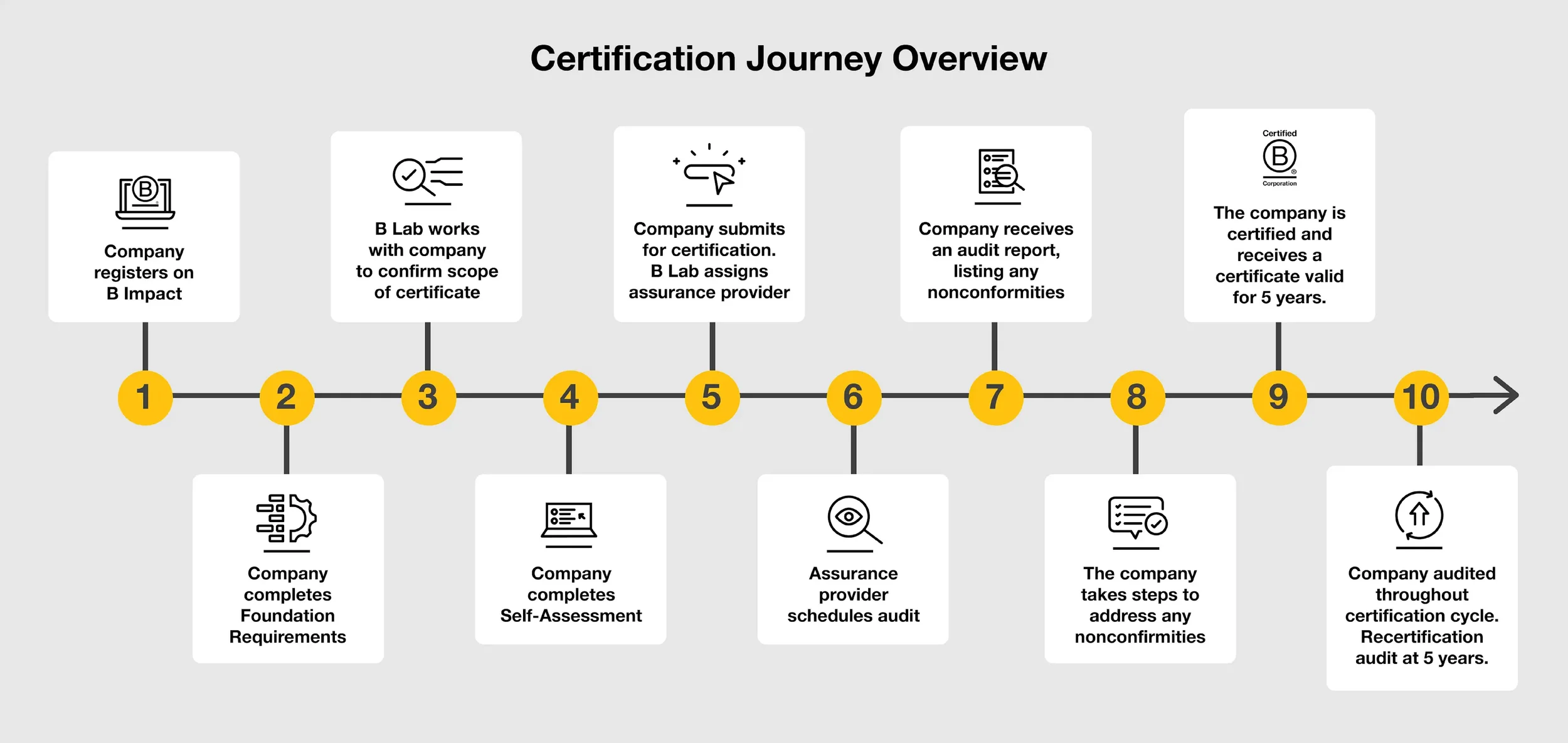
B Corp 101: A Quick Overview (2026)

What Is a B Corp?

Certified B Corporations—“B Corps” for short—are businesses that meet high standards of social and environmental performance, accountability, and transparency.

Think of it like LEED certification for buildings or USDA Organic for food. The difference is that B Corp certification covers the entire company, not just a single product or process. It looks at how a business treats its workers, how it impacts the environment, how it engages with communities, how it governs itself, and even how it shows up in the marketplace.

This big-picture approach matters. It helps us tell the difference between companies that are truly committed to positive impact and those that are just doing clever marketing.

Today, there are thousands of B Corps around the world, across nearly every industry. They’re united by a shared goal: to use business as a force for good.

How Do You Become a B Corp (Under the New Standards)?

B Lab, the nonprofit that runs B Corp certification, introduced a major update to the standards (called Version 2.1). While the heart of the process hasn’t changed—businesses still need to show strong performance, legal accountability, and transparency—the way it all works is now clearer and tougher.

Here’s what that means in practice:

  • Performance
    Instead of aiming for a certain number of points on the old B Impact Assessment, companies now need to meet specific minimum requirements across seven key areas:

    • Purpose & Governance

    • Climate Action

    • Human Rights

    • Fair Work

    • Environmental Stewardship & Circularity

    • Justice, Equity, Diversity & Inclusion (JEDI)

    • Collective Action & Policy

    There’s also a new “risk check” that looks at things like industry involvement or client relationships. Depending on the results, companies might have to meet extra requirements to certify.

  • Legal Accountability
    B Corps must legally commit to considering all stakeholders—not just shareholders—in their decision-making. In practice, this often means updating your bylaws or governance structure to ensure people, planet, and community are part of the business equation.

  • Transparency
    Every B Corp publishes information about their impact publicly on the B Corp website. This isn’t about airing every detail of your operations—it’s about being clear on your commitments, your risk profile, and the areas where you’re meeting the new standards.

  • Continuous Improvement
    Certification isn’t a one-time badge. The new standards lay out a path where companies meet certain requirements at the start, then add more ambitious ones in Year 3 and Year 5. The idea is that B Corps are always raising the bar, not just checking the same boxes every few years.

Who Can Certify?

Most for-profit companies—from LLCs and corporations to cooperatives and employee-owned businesses—can certify. Nonprofits and government agencies cannot. There are also new rules about certain industries (like fossil fuels, gambling, or tobacco) and stricter oversight for companies with high-risk revenue streams.

Why Become a B Corp?

So why go through this process? A few of the biggest reasons:

  • Trust and Credibility: Certification shows customers, employees, and investors that your business is serious about impact—not just talk.

  • Attracting Talent: More and more people want to work for companies with values. B Corps stand out as employers of choice.

  • Community: You join a global movement of businesses learning from one another and working together for bigger change.

  • Improvement: The process itself pushes you to do better—on climate, equity, governance, and more.

Is It Right for Your Business?

Becoming a B Corp is a real commitment. It takes time, effort, and a willingness to keep improving. But if your company is serious about aligning values with operations, it can be one of the most powerful steps you take.

Even if you don’t certify right away, exploring the standards can help you see where you’re strong and where you can grow. That alone can be a game-changer.

Conclusion

In a world where businesses are increasingly held accountable for their impact on society and the environment, B Corp certification offers a clear pathway to demonstrate your commitment to doing good. By becoming a B Corp, your company joins a global movement of businesses that believe in using business as a force for good. The journey may be challenging, but the impact—on your company, your stakeholders, and the world—can be profound.

Questions? Curious to learn more? Here are some resources our team has put together for you:

You can also contact us directly by filling out the form below: